
Product Page SEO Best Practices
Title-tag patterns for products, structured-data implementation (Product, Offer, Review), unique-content vs manufacturer copy, image SEO, and category-page linking.
Last updated:
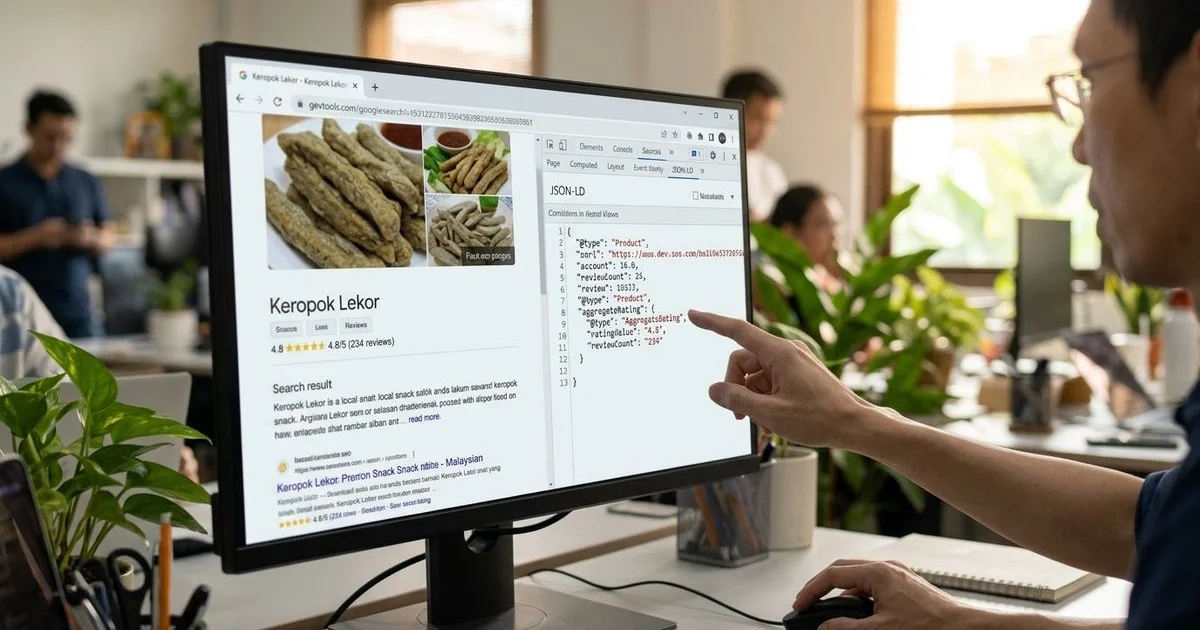
The product page is the moment of truth
In Malaysian e-commerce, the product page has to do two jobs perfectly. It is the main landing spot for anyone finding you through a Google search, and it is the last step before a customer decides to buy.
Many online stores struggle with both. They often use standard templates with generic descriptions from the manufacturer, lack crucial schema data, and have a weak internal linking structure.
Our approach with Our E-commerce SEO service puts product pages first. This is where search engine optimisation (SEO) and conversion rate optimisation (CRO) work together.
Here are the product page SEO best practices that we use to boost both rankings and revenue.
Title-tag patterns that win SERPs
The title tag is one of the most important factors for getting shoppers to click on your link in Google search results. For Malaysian e-commerce, we see three patterns that consistently perform well.
Pattern A: Product + Specifics + Brand
This is the classic, trusted format: “Wireless Mesh Router AX5400 Wi-Fi 6 | TechBrand Malaysia.” It’s clear, easy to scan, and includes both what the buyer is looking for and the brand name. You’ll see this used by major platforms like Lazada and Shopee.
Pattern B: Benefit + Product + Brand
This pattern works best when the main benefit is what people are actually searching for: “Bedroom-Quiet 1HP Aircon with 7-Day Cool Boost | CoolBrand.” It’s especially effective for shoppers who are moving from researching a problem to buying a solution. A well-written, benefit-led title can lift your click-through rate (CTR) significantly.
Pattern C: Product + Variant + Price Anchor + Brand
When price is a key selling point in a category, this pattern is effective: “Premium Leather Wallet RFID-Blocking | RM 159 | LeatherBrand.” Be aware that if your price changes, you must update the title tag to avoid misleading customers.
A pro-tip is to use Google Search Console to monitor the CTR of your key product pages. If a page has high impressions but a low CTR, testing a new title tag is often the quickest way to get more traffic.
Structured data: Product, Offer, Review, AggregateRating
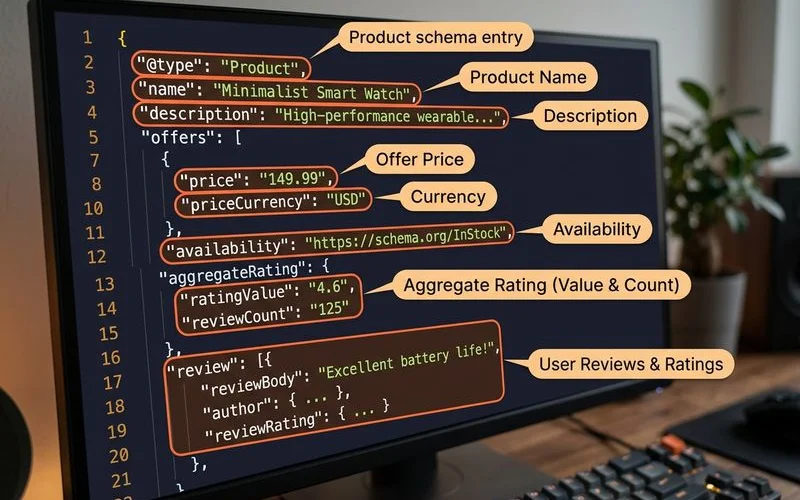
Implementing schema markup is the single most effective technical SEO task for product pages. It’s code that helps Google understand your page and show richer results, like star ratings and prices, directly in the search listings. These enhanced listings, often called rich snippets, can increase your click-through rate by up to 35% because they stand out from plain blue links.
Here are the three essential schemas for every product template.
- Product schema: This tells Google the product’s name, description, brand, SKU, and image. It is mandatory for any e-commerce page.
- Offer schema (nested in Product): This provides the price, currency (e.g., MYR), and availability (like
InStock). This information is critical for appearing in product-related rich results. A common mistake is not using the full Schema.org URL for availability, which can cause validation errors. - AggregateRating schema (nested in Product): This is used only when a product has customer reviews and is required to earn the valuable star ratings in search results.
- Review schema: This is for individual reviews shown on the page, including the reviewer’s name and the rating given.
You don’t need to code this manually. You can use free tools like Google’s Rich Results Test or Schema Markup Generator to create the required JSON-LD code. For more detailed examples, read our schema markup for online stores guide.
Unique content vs manufacturer copy
Using the same product descriptions provided by the manufacturer is a widespread problem. When dozens of your competitors use the exact same text, Google has difficulty deciding which one to rank. Usually, the algorithm will favour the website with the highest overall authority, pushing everyone else down.
The solution is to write unique descriptions, starting with your most important products. We recommend focusing on the top 20% of products that generate the most revenue.
A good product description should be 200-400 words and do the following:
- Start by describing who the product is for, such as “perfect for small Malaysian apartments” or “ideal for daily commuting in KL.”
- Explain the top 3-5 features using language your buyers would use, not technical jargon.
- Address the most common questions or concerns customers have. A great place to find these is in your own customer emails or live chat logs.
- End with a clear instruction, like “add to cart” or “compare models.”
Writing unique content does more than just help with SEO. Studies have shown that 87% of shoppers rate product content as extremely important when deciding to buy, and half have returned a product because the description was inaccurate.
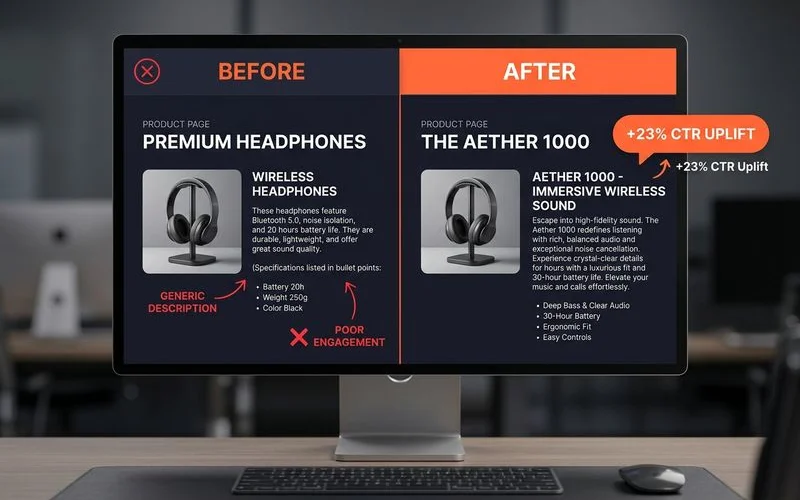
Image SEO that compounds
In many Malaysian e-commerce categories, Google Image Search can be a significant source of traffic. Proper image optimisation is essential for both search visibility and user experience.
Descriptive alt text: Every image needs alt text that describes what it is, such as “Black leather wallet with RFID blocking and 8 card slots.” This helps both search engines and visually impaired users.
SEO-friendly file names: Change generic file names like “IMG_4823.jpg” to something descriptive like “leather-wallet-rfid-black.jpg” before you upload the image. Use hyphens to separate words.
Modern formats and responsive sizes: The WebP image format is now the standard for the web. At a quality setting of 75-85, a WebP file is often 30-50% smaller than a similar JPEG. You can use free online tools like Squoosh to convert your images. This is crucial for page speed, especially in a mobile-first market like Malaysia. A 1-second delay in mobile page load time can reduce conversions by up to 7%.
ImageObject schema: This specific schema helps search engines understand the content of your images and connect them back to the main Product schema.
Internal linking from category pages
This is a frequently overlooked part of product page optimisation. Your category pages should act as hubs, distributing authority down to your most important product pages. Don’t just list products alphabetically; strategically link to the 12-20 products with the best profit margins or highest revenue.
Here is the four-step pattern for a strong internal linking structure:
- The category page links to its top products.
- Each product page links back to its parent category using breadcrumbs.
- Each product page links to 4-6 “related products”.
- The homepage links to the top 3-5 most important category pages.
A simple rule of thumb is that your key product pages should be reachable within three clicks from your homepage. This structure, supported by proper Breadcrumb schema, provides a clear map for Google, helping it rank the right pages for the right search queries. You can use tools like Screaming Frog SEO Spider to visualise your site structure and find pages that are buried too deep.
Our process for e-commerce clients
When we take on a new e-commerce client, our focus on product page SEO best practices is immediate and methodical.
In the first month, we conduct a complete audit of the product page template, implement schema across the top 20% of revenue-driving products, and rebuild the internal linking architecture to flow authority correctly.
From the second month onward, we begin rewriting manufacturer copy for the most valuable SKUs, optimising all product images, and coordinating with the store’s tools to increase customer reviews.
Want this level of detail for your store? Request a discovery call.
Quick Answers
Should I rewrite manufacturer descriptions?
How important is product-page review count?
Do I need every product page to be unique?
Related Guides
E-commerce SEO vs Google Shopping Ads — Which Wins?
Cost-per-acquisition over time, when Shopping Ads make sense (launch, low authority), when SEO wins (margin, brand), and the hybrid approach for mature stores.
Schema Markup for Online Stores
Product / Offer / AggregateRating / Review / Breadcrumb schemas explained with working JSON-LD examples, validation tools, and the impact on click-through rate.
Ready for the service?
Learn more about E-commerce SEO
Tailored organic-growth strategies for Malaysian and regional online stores — product page SEO, category architecture, structured data, and CRO-integrated growth.
Explore the E-commerce SEO Service