
E-commerce SEO vs Google Shopping Ads: Which Wins for Your Store?
Cost-per-acquisition over time, when Shopping Ads make sense (launch, low authority), when SEO wins (margin, brand), and the hybrid approach for mature stores.
Last updated:
The honest comparison
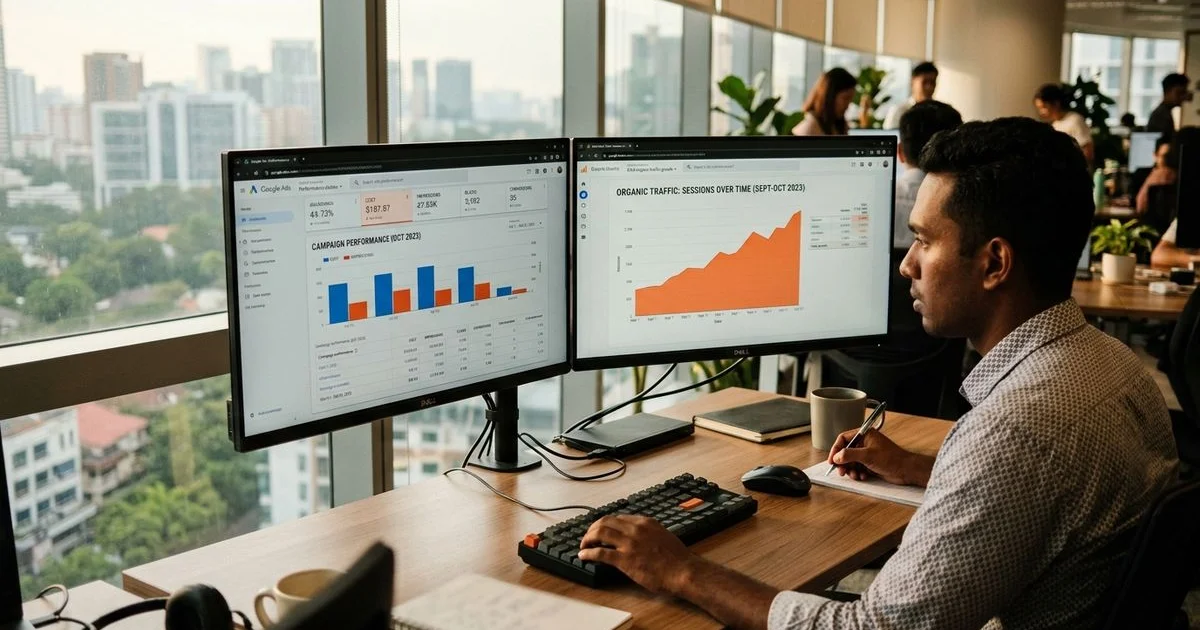
You know how this debate goes in every budget meeting. Should we put more money into ads for quick sales, or invest in SEO for long-term growth? Most e-commerce founders ask this question backwards, trying to find out which channel is “better”. The honest answer is that each one solves a different problem on a different timeline.
In our experience since 2011, nearly every mature Malaysian store runs both. The real question is about the mix.
The Malaysian e-commerce market is projected to hit USD 23.11 billion by 2031, so the traffic is there for the taking. Our E-commerce SEO service covers the organic side of capturing that traffic. This guide compares it directly against Google Shopping Ads to help you make the right channel-mix decision for your store’s current stage.
How the two compare: E-commerce SEO vs Google Shopping
| Metric | Google Shopping Ads | E-commerce SEO |
|---|---|---|
| Time to first sales | Day 1 | 8-16 weeks |
| Cost-per-acquisition month 1 | Variable, often high | Higher than ads |
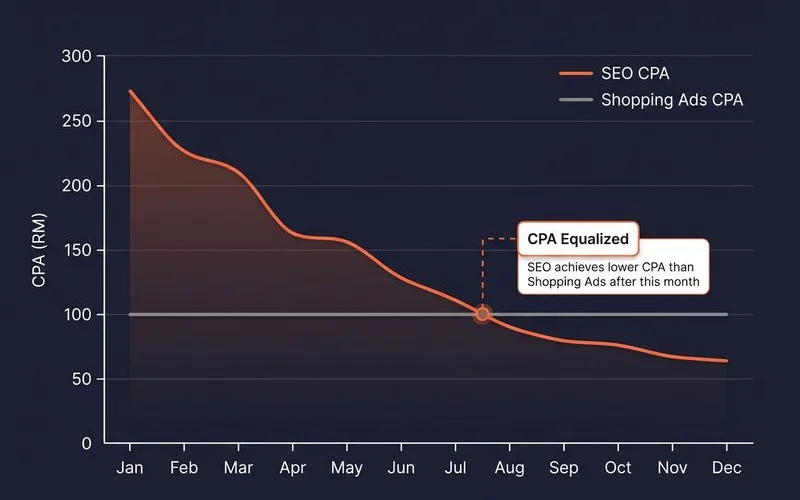
| Cost-per-acquisition month 12 | Same or rising | Typically half of ads |
| Switch-off impact | Sales stop immediately | Sales continue |
| Compounding effect | None | Compounds monthly |
| Best for new product launches | Strong | Slow |
| Best for branded queries | Wasteful | Strong |
| Best for category research | Limited | Strong |
| Inventory sync needs | Required (product feed) | Optional |
| Margin pressure | High (auction-based) | Low (organic) |
That “compounding effect” column is the most important one for margin-sensitive stores. Ads essentially rent traffic, which gets more expensive as competition increases. A 2025 report noted that Google Ads CPC in some industries rose by over 60% in just one year. In contrast, SEO builds a business asset. A high-ranking collection page or blog post can bring in qualified visitors for years, long after the initial investment.
When Shopping Ads wins
There are three scenarios where Google Shopping is the right primary channel.
New stores under 6-12 months old
A new domain has almost no authority, so product pages won’t rank for competitive terms. It generally takes 3 to 6 months for a new Malaysian website to even start appearing consistently in search results for its target keywords. Shopping Ads provide immediate visibility to bridge that gap while foundational E-commerce SEO foundation work begins to compound.
New product launches in competitive categories
A fresh SKU has no sales data or ranking history. Shopping Ads are perfect for testing market demand and generating initial sales while the organic ranking builds over the next few months. This is especially critical for seasonal campaigns with tight windows, like for Hari Raya or Chinese New Year collections, where you can’t afford a slow start. For these campaigns, optimising product listings in Google Merchant Center with seasonal keywords, like “Baju Raya 2026,” is crucial.
Stores with weak product-page UX or thin descriptions
Shopping Ads can still drive conversions even if a product page isn’t perfectly optimised for SEO. The ad’s visual appeal and price point do the initial selling. SEO, on the other hand, depends on the page being strong enough to both rank and convert. Research shows that even a one-second page load delay can cut conversions by 7%. Shopping Ads need the page to convert, but SEO needs it to be technically sound, persuasive, and fast.
Comparison-shopping queries
Buyers who are close to making a decision often click on Shopping placements. The visual format with the price, picture, and store name is highly effective at this stage. You can enhance these ads further through the Google Merchant Center by adding promotions or integrating product reviews to build trust right in the search results.
When SEO wins
The opposite scenarios also hold true. SEO is the clear winner for mature stores, high-margin products, and building long-term brand equity.
Mature stores with established authority
Once your store has been around for a year or more and has built some domain authority, SEO becomes far more efficient. It allows you to rank for thousands of long-tail informational and category-level keywords that would be too expensive to target with ads.
High-margin products where CPA is critical
This is where the compounding power of SEO really shines. Our 283% revenue case study is the perfect example. The store had been running Shopping Ads for years, and their cost-per-acquisition (CPA) had climbed to RM 220. After 10 months of focused SEO and conversion rate optimisation, their organic CPA dropped to just RM 78, a reduction of nearly 65%. This allowed them to significantly cut their paid ad spend while increasing overall profitability.
Branded search queries
Spending on ads for your own brand name is often inefficient. Users searching for “[Your Brand] shoes” already know you and were likely to click the top organic result anyway. Branded organic searches can have click-through rates (CTRs) that are 2 to 3 times higher than non-branded ones, making organic the most effective channel for capturing this high-intent traffic.
The hybrid approach for mature stores
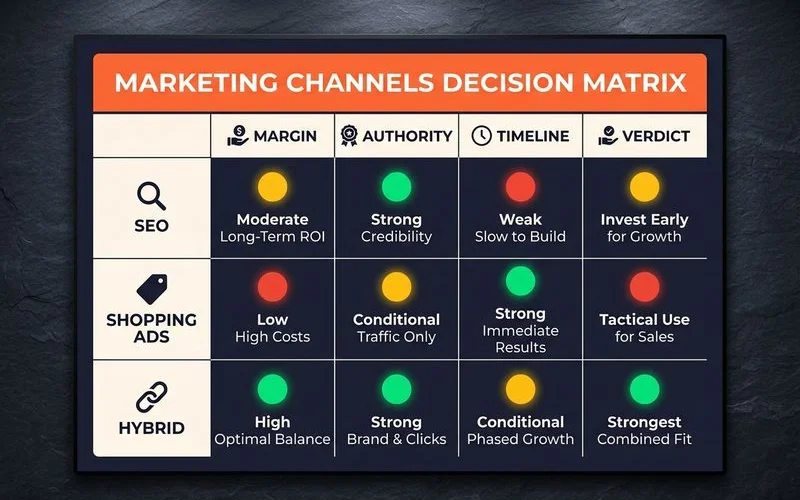
For any Malaysian e-commerce store that has survived its first year, the answer is almost always a mix of both channels. The right split simply changes as your business grows. The key is to see them not as competitors for your budget, but as complementary tools.
We recommend evolving your channel mix based on your store’s lifecycle.
- Year 1 (0-12 months): 80% Shopping Ads / 20% SEO. Ads are the primary driver of sales while the foundational SEO work gets started. You shouldn’t expect significant organic revenue in the first year.
- Year 2 (12-24 months): 50% / 50%. Organic traffic starts to become a reliable sales channel. Shopping Ads remain essential for new product launches and targeting highly competitive keywords. Your blended CPA should start to improve noticeably.
- Year 3+ (24+ months): 30% Shopping Ads / 70% SEO. Organic traffic should now be your primary engine, capturing most of the branded, informational, and long-tail traffic. Shopping Ads can be used more surgically for new launches, seasonal campaigns, and defending your position on ultra-competitive commercial terms.
How to decide your next quarter’s split
Here are three quick filters based on your current ad spend and business stage.
If your monthly Shopping spend is RM 5K-15K and your store is under 18 months old, keep the majority of your budget in Shopping. We would suggest adding a Standard tier SEO retainer (RM 2,500/mo) to build your long-term foundation. You can then re-evaluate the mix every quarter.
If your monthly Shopping spend is RM 20K-50K and you notice your CPA is rising, it’s time to shift. We recommend moving to a Premium tier SEO retainer (RM 4,500/mo) and planning to reallocate 20-30% of your Shopping budget to SEO over the next year. You should expect to see an improvement in your blended CPA by month nine.
If your monthly Shopping spend is RM 50K+ and you’re feeling pressure on your margins, an aggressive move towards SEO is the most logical step. An Elite tier SEO plan (RM 9,500/mo) should be paired with the clear goal of replacing 30-50% of your ad spend within 18 months. The compounding returns at this scale are significant.
You can also read our broader SEO vs Google Ads comparison for a look at the channel-mix logic for businesses outside of e-commerce.
Want a custom channel-mix forecast for your store? The best next step is to Request a discovery call so we can look at your specific numbers.
Quick Answers
Can I run both?
Which is better for new stores?
Does Shopping Ads spend help my organic rankings?
Related Guides
Product Page SEO Best Practices (2026 Edition)
Title-tag patterns for products, structured-data implementation (Product, Offer, Review), unique-content vs manufacturer copy, image SEO, and category-page linking.
Schema Markup for Online Stores
Product / Offer / AggregateRating / Review / Breadcrumb schemas explained with working JSON-LD examples, validation tools, and the impact on click-through rate.
Ready for the service?
Learn more about E-commerce SEO
Tailored organic-growth strategies for Malaysian and regional online stores — product page SEO, category architecture, structured data, and CRO-integrated growth.
Explore the E-commerce SEO Service