
SEO vs Google Ads: Which Actually Delivers Better ROI?
Side-by-side cost-per-lead comparison over 12-24 months for Malaysian businesses. When ads win, when SEO wins, and why most growth budgets need both.
Last updated:

The honest framing question
You know how every founder asks the same question on a discovery call? They want to know if they should spend their marketing budget on SEO or on Google Ads. The honest answer most agencies won’t give is that they need both.
It’s not about choosing one over the other. The two channels solve different problems on different timelines. A smart, hybrid approach almost always outperforms a strategy that relies on only one. The Malaysian e-commerce market alone is projected to hit USD 23.11 billion by 2031, so the competition for attention is fierce.
We’ll break down how these two powerful channels compare, when to prioritise one over the other, and how to blend them for the best results. For a deeper dive into our methodology, you can read our 4-Stage Framework, then come back to this comparison.
How the two compare on the metrics that matter
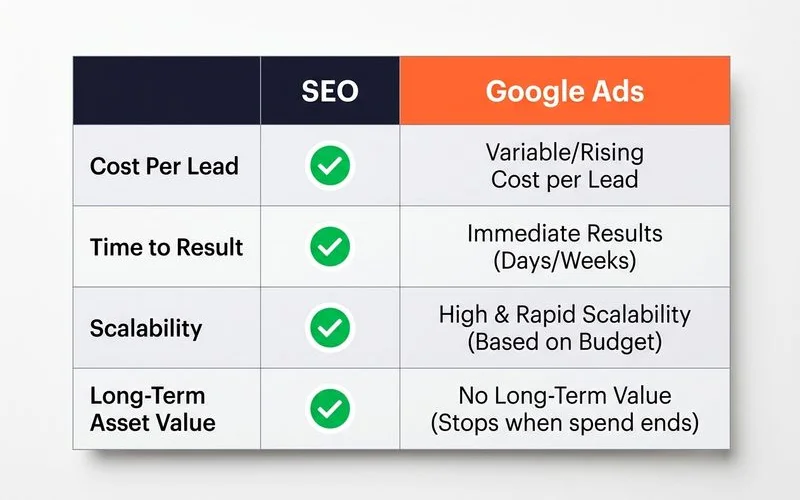
| Metric | Google Ads | SEO |
|---|---|---|
| Time to first leads | Day 1 | 8-16 weeks |
| Typical SME monthly cost (MY) | RM 3,000 - RM 10,000+ | RM 2,000 - RM 8,000+ |
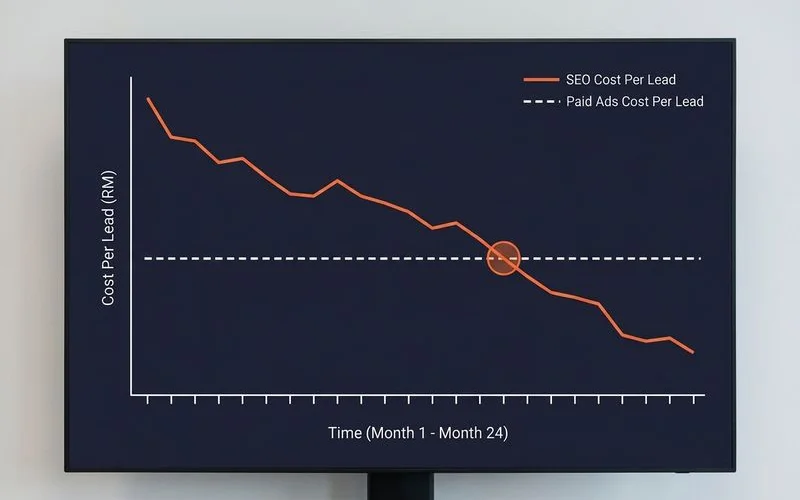
| Cost-per-lead month 1 | Baseline | Higher than ads |
| Cost-per-lead month 12 | Same or rising | Typically half of ads |
| Cost-per-lead month 24 | Same | Often a third or less |
| Switch-off impact | Leads stop immediately | Leads continue for months |
| Audience Targeting | Hyper-specific (demographics, location, interests, remarketing) | Broad (based on keyword intent) |
| Compounding | None | Compounds monthly |
| Best for branded queries | Limited | Strong |
| Best for high-intent commercial | Strong | Strong (slower ramp) |
| Best for informational research | Wasteful | Strong |
When Google Ads wins
There are three clear scenarios where Google Ads should be your primary investment, not SEO.
Brand-new businesses with no organic authority
A fresh website with no backlinks or content history is unlikely to rank for competitive Malaysian terms within six months. Google Ads buys you the immediate pipeline you need while your SEO strategy works on building a long-term asset. This allows you to start gathering crucial customer data from day one.
Seasonal spike businesses
Think about F&B promotions for Ramadan, end-of-year retail pushes for Christmas, or major Chinese New Year campaigns. SEO simply can’t react effectively within a 30-day window. With Google Ads, you can launch a campaign and start seeing traffic almost immediately, capturing that peak seasonal demand.
Geographic or product expansion you need to test fast
Want to test if your B2B manufacturing service converts as well in Penang as it does in Kuala Lumpur? Google Ads can provide directional data on leads and cost-per-acquisition within a month. An SEO campaign would require at least six months to gather similar insights.
When SEO wins
The inverse is also true. SEO is the clear winner in situations where long-term value outweighs the need for immediate speed.
Margin-sensitive and high-trust categories
For businesses where cost-per-lead is critical, SEO is the more sustainable choice. We see this with professional services like law firms or specialist medical clinics in competitive areas like Kuala Lumpur. Some legal keywords can exceed RM 50 per click, making a paid ads campaign incredibly expensive over time. SEO allows you to capture these high-value leads at a fraction of the cost.
Branded query capture and defensibility
When buyers already know your brand name, they are likely to click on the organic search result rather than a paid ad. SEO ensures you capture this high-intent traffic efficiently. This effort builds a defensible moat around your brand, creating a barrier that competitors can’t easily overcome just by increasing their ad spend.
The 283% revenue case study detailed in our methodology post is a perfect example of an SEO win. The client could have spent the equivalent retainer on ads and received ten months of pipeline that would have vanished the moment they stopped paying. Instead, they invested in an asset that continues to generate revenue today.
The hybrid recommendation
For most Malaysian SMEs in growth mode, the right answer is almost always both. You can run ads to cover your short-term pipeline needs while running SEO to compound your long-term digital asset.
Our team typically recommends a 60/40 budget split in favour of Google Ads at the start of an engagement. This initial ad spend generates immediate leads and provides valuable data on which keywords convert best. This insight then fuels a more effective SEO strategy. By month 12, as organic search starts to deliver consistent results, this split usually flips to 30/70.
This hybrid approach allows total leads to grow while the blended cost-per-acquisition falls. More importantly, you build a defensible market position that competitors can’t simply outspend.
Want a hybrid budget model for your specific business? Request a discovery call, and we’ll help forecast the projected split based on your industry, profit margin, and business goals.
Quick Answers
Can I run SEO without Google Ads?
When does it make sense to pause ads?
Is there a recommended budget split?
Related Guides
The Adam SEO 4-Stage 9-Step SEO Framework Explained
Inside the Adam SEO methodology: 4 stages (Analysis, CRO, Optimization, Re-Engagement) and the 9 specific steps that turn organic traffic into revenue.
Common SEO Myths and Misconceptions (Debunked for 2026)
Myth-busting on guaranteed rankings, link buying, keyword stuffing, 'SEO is dead' claims, and AI replacing SEO. What actually moves the needle in 2026.
How Long Does SEO Take to Show Results in Malaysia?
Realistic SEO timeline: technical quick wins in month 1, ranking movement by months 3-4, meaningful revenue impact by months 4-8 for Malaysian businesses.
How to Choose an SEO Agency in Malaysia (2026 Buyer's Guide)
What to look for in a Malaysian SEO agency: red flags, the right questions to ask in discovery, and reporting standards that separate operators from sellers.