
How Long Does SEO Really Take to Show Results?
Realistic SEO timeline: technical quick wins in month 1, ranking movement by months 3-4, meaningful revenue impact by months 4-8 for Malaysian businesses.
Last updated:

You know how every business owner wants to know the exact day their SEO investment will pay off? It’s the million-dollar question, and rightly so. You’re putting down a serious budget, and you need to know when the returns will show up.
After more than a decade in this field, starting with our founder Adam Yong back in 2011, we’ve seen that while there’s no magic date, there is a predictable pattern to SEO success in Malaysia.
The general consensus from multiple studies and our own client data is that meaningful results typically appear between the 3 to 6-month mark.
But that’s just an average. The real story is in the details, which depend heavily on your starting point, your industry, and the intensity of your strategy.
So, let’s break down the timeline we use to set expectations with our clients. We will look at what happens month by month, what factors can speed things up or slow them down in the Malaysian market, and why this is an investment that builds value over time, unlike paid ads.
The honest timeline
SEO is a long-term play, and any agency that tells you otherwise should be a red flag. But “long-term” doesn’t mean “vague”. Here’s the timeline we set with every new Malaysian client on the 4-Stage Framework.
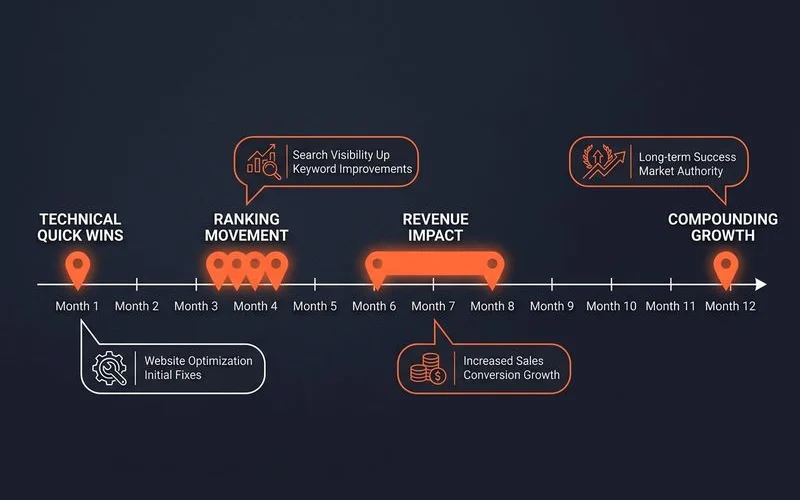
Month 1 — Quick wins ship
The first 30 days are all about foundational fixes that can deliver surprisingly fast signals. Technical issues often hold a site back, so resolving them is our first priority.
Using tools like Google Search Console and Ahrefs’ Site Audit, we identify and fix problems like broken canonicals, missing schema markup, and slow Core Web Vitals. These fixes can lead to a jump in search impressions within just 2 to 4 weeks. Google’s focus on page experience is so significant that improving your Core Web Vitals, like loading speed, is one of the quickest ways to earn a modest rankings lift.
Months 2-4 — Ranking movement
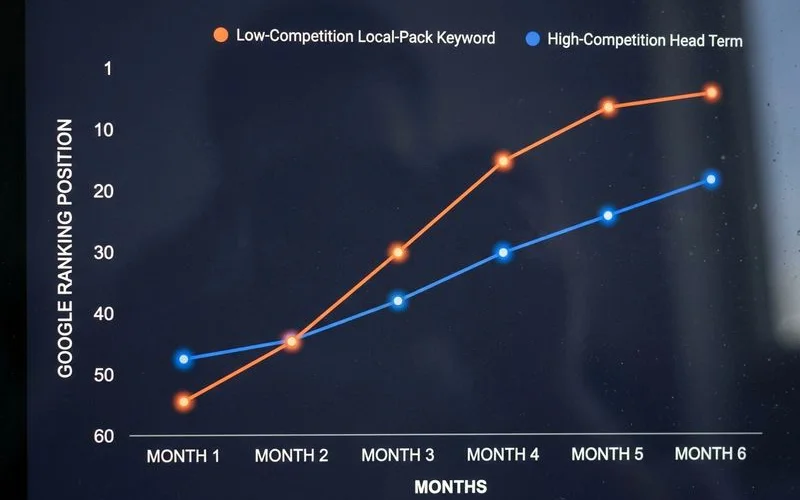
This is when the consistent effort in content creation and link acquisition starts to pay off with measurable ranking changes. Low-competition local keywords, like “best nasi lemak in Bangsar” or “tyre shop near me,” often break into the top-3 of Google’s local pack results during this phase.
For more competitive commercial terms, this is when you’ll see pages climbing into the 11-30 ranking positions. It’s a crucial sign of building momentum, showing that Google is beginning to trust your site’s authority on the topic.
Months 4-8 — Meaningful revenue impact
This is where the compounding effect of SEO really becomes visible on your bottom line. By this stage, organic traffic has often doubled or tripled from its starting point.
Because our framework includes conversion rate optimisation (CRO) work from the beginning, the value of each visitor is higher. By month 8, it’s common for our engagements to have generated more new revenue than the total cost of the SEO retainer. This is the turning point where SEO shifts from a cost centre to a profitable growth engine.
Months 9-12 — Cost-per-acquisition collapses
By the end of the first year, your fixed retainer costs are spread across a much larger and still-growing base of organic traffic. The cost to acquire a lead or sale from organic search typically falls to a fraction of what you’d pay on channels like Google Ads.
At this point, SEO solidifies its position as the highest-ROI channel in your marketing mix. The asset you’ve spent a year building is now generating predictable returns that continue to grow.
What compresses or extends the timeline
Five factors can swing your SEO timeline by 30-60% in either direction. Understanding where you stand on these points is key to setting realistic expectations.
Domain age and existing authority
A 5-year-old domain with a clean backlink history will almost always rank faster than a brand-new one. New domains often experience what SEO professionals call the “sandbox” effect, a period of 4-6 months where Google is cautious about granting them top rankings for competitive terms. An established website that already has some authority can often see results in half that time.
Competition density in your category
The more businesses fighting for the same keywords, the longer it takes to rank. Highly competitive niches in Malaysia, such as legal services in Kuala Lumpur, dental clinics in Bukit Bintang, or B2B manufacturing in Penang, can take 6 to 12 months or more to secure top rankings.
In contrast, niche service categories with less competition, like custom medical devices or specialised B2B SaaS for the Malaysian market, can see significant movement much faster simply because the competitive landscape is thinner.
Budget tier
Content velocity is a major driver of results. Our Standard tier at RM 2,500/month targets around 30 keywords with 2 new content assets per month. The Elite tier, at RM 9,500/month, allows us to target over 120 keywords and produce 8-12 content assets monthly.
This increased output directly accelerates how quickly we can build your website’s topical authority. More high-quality content helps Google see your site as a comprehensive resource, which is a key ranking factor, especially since Google’s Helpful Content Updates.
Technical foundation at kickoff
Some websites come to us with significant technical debt. This can include major indexation problems, poor site structure, or a history of penalties from previous low-quality SEO work. In these cases, we have to spend the first 60-90 days just fixing the foundation before we can even begin the work that builds rankings. A site with a solid technical setup can skip this delay and move straight into content and authority building.
Whether CRO ships in parallel
SEO drives traffic, but Conversion Rate Optimisation (CRO) turns that traffic into revenue. Skipping the CRO stage means that even as your rankings and traffic grow, you’re leaving money on the table. When CRO is bundled with SEO, every ranking improvement has a multiplied impact on your bottom line because a higher percentage of visitors are converting into customers.
Why SEO compounds where ads decay
This is the most important concept to grasp when you’re having budget conversations. It’s the fundamental difference between renting and owning.
Google Ads delivers traffic immediately, which is great for short-term campaigns. However, the moment you stop paying, the traffic stops. Completely. Every ringgit spent on ads is a temporary rental of visibility; none of that value accumulates.
SEO is the inverse. It’s about building a valuable digital asset. The content you create in month 3 can continue to rank and generate leads in month 18 and beyond. The authoritative links you earn in month 6 will keep passing value for years. Every month you invest, the asset grows stronger.
| Feature | Google Ads (PPC) | SEO |
|---|---|---|
| Speed to Results | Immediate, within hours of campaign launch. | Slower, takes 3-6 months for initial results. |
| Cost Over Time | Continuous pay-per-click cost. | Upfront investment, then lower ongoing cost. |
| Long-Term Value | Stops as soon as you stop paying. | Compounding, long-lasting asset. |
| Trust Factor | Lower, as users know it’s a paid ad. | Higher, organic results are seen as more credible. |
The first few months of an SEO campaign can feel slow because you are paying to build an asset, not just buying traffic. But around the six-month mark, the math begins to reverse. By month 12, the cost-per-lead from organic search is often less than half of paid channels. By month 24, that gap usually widens even further.
Want a realistic forecast for your business? — Request a discovery call and we’ll model the projected timeline against your specific category and budget.
Quick Answers
Can I see results faster than 4 months?
What if I switch from another agency mid-campaign?
Why do some keywords move faster than others?
Related Guides
The Adam SEO 4-Stage 9-Step SEO Framework Explained
Inside the Adam SEO methodology: 4 stages (Analysis, CRO, Optimization, Re-Engagement) and the 9 specific steps that turn organic traffic into revenue.
Common SEO Myths and Misconceptions (Debunked for 2026)
Myth-busting on guaranteed rankings, link buying, keyword stuffing, 'SEO is dead' claims, and AI replacing SEO. What actually moves the needle in 2026.
How to Choose an SEO Agency in Malaysia (2026 Buyer's Guide)
What to look for in a Malaysian SEO agency: red flags, the right questions to ask in discovery, and reporting standards that separate operators from sellers.
SEO ROI — What Should You Realistically Expect?
How SEO ROI is calculated, realistic break-even timelines per retainer tier, and what an Adam SEO 283%-revenue case study actually looked like month-by-month.