
Google Business Profile Optimization for Malaysian Businesses
Full GBP playbook for Malaysian businesses: category selection traps, photo/post cadence, review acquisition tactics, and the bilingual NAP-consistency mistakes to avoid.
Last updated:
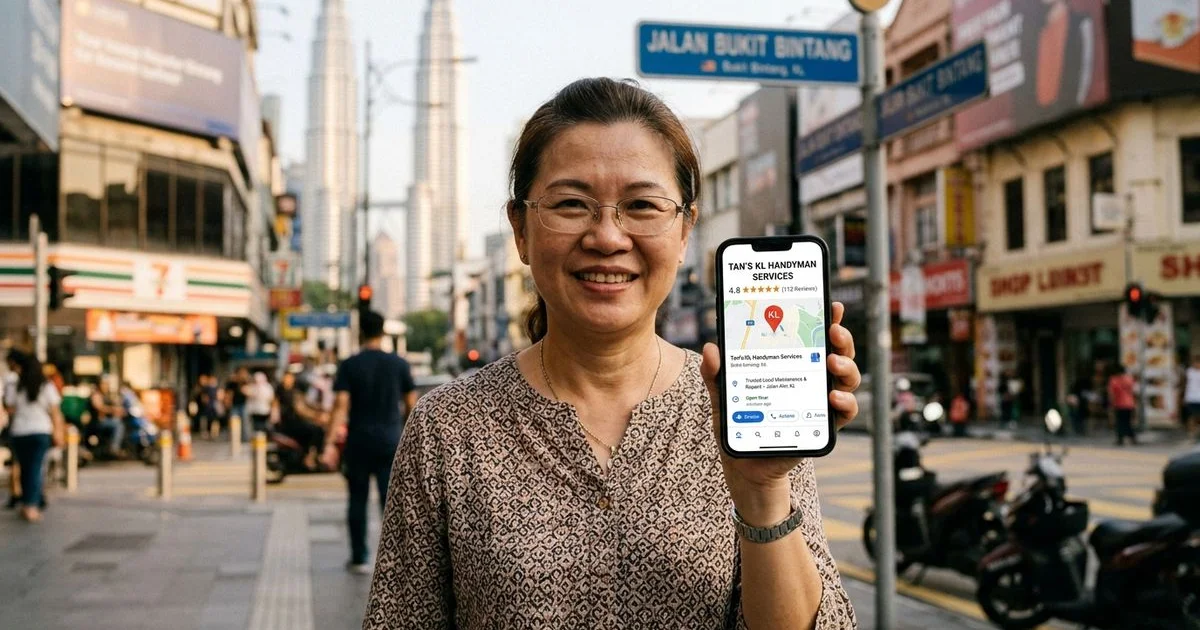
Why GBP is the highest-leverage Local SEO investment
You know how some marketing channels feel like a constant uphill battle? Google Business Profile, or GBP, is the exact opposite for most Malaysian businesses. It’s still the most direct path to appearing in front of customers who are searching for you right now.
As an SEO agency offering Local SEO services since our founding in 2011, we’ve seen platforms come and go. GBP, formerly Google My Business, remains the most critical local SEO investment.
It’s what gets you into the Google 3-pack, the map results, and the prominent local listings that show up before the regular blue links. Data shows that 97% of Malaysians use search engines to find local businesses, and a well-optimised GBP is your ticket to being seen by them.
A strong profile doesn’t just get you seen, it gets you clicks. The top three Google Maps positions receive about 90% of the click-through traffic for local searches. A weak or unoptimised profile often doesn’t show up at all.
Here’s how we ensure our clients’ profiles are set up to capture that traffic.
The setup that wins
Getting the foundation right is everything. A correctly configured profile sends all the right signals to Google and sets you up for long-term visibility.
Claim and verify the listing
Postcard verification is still the most dependable method in Malaysia for businesses with a physical location. While phone and video options exist, especially for service-area businesses, they can sometimes add delays.
Crucially, always claim the listing using the business owner’s primary email address. Never use an agency or staff member’s email. We’ve seen businesses lose access to their profiles years later because a former employee controlled the login. Regaining ownership can be a difficult process.
Set the primary category carefully
This is the single most important field on your profile. It tells Google the main service you provide, and getting it wrong can make your rankings disappear overnight. You have to choose from Google’s list of nearly 4,000 preset options, so the key is to be as specific as possible.
For a Malaysian business, this means choosing “Klinik Pergigian” over the broader “Pusat Kesihatan,” or “Kedai Roti” instead of just “Kedai Makanan.” Specificity wins.
Add 5-10 secondary categories
These categories allow you to capture searches for related services. A law firm specialising in property might set its primary category as “Conveyancer” but add secondary categories like “Real Estate Attorney” and “Notary Public.”
A word of caution: don’t stuff this section with irrelevant terms. Google’s algorithm is smart enough to detect when categories don’t match the other information on your profile, which can hurt your credibility. The best practice in 2026 is to add only 2 to 3 highly relevant secondary categories to avoid diluting your primary focus.
Service area for SABs
If you are a service-area business (SAB), like a plumber or a home cleaner who travels to customers, you must hide your physical address and define your service areas by city or postal code. This is one of the most common mistakes we see with Malaysian GBP listings. Listing a home address when you don’t have a public storefront is a direct violation of Google’s guidelines and can lead to profile suspension.
The ongoing cadence
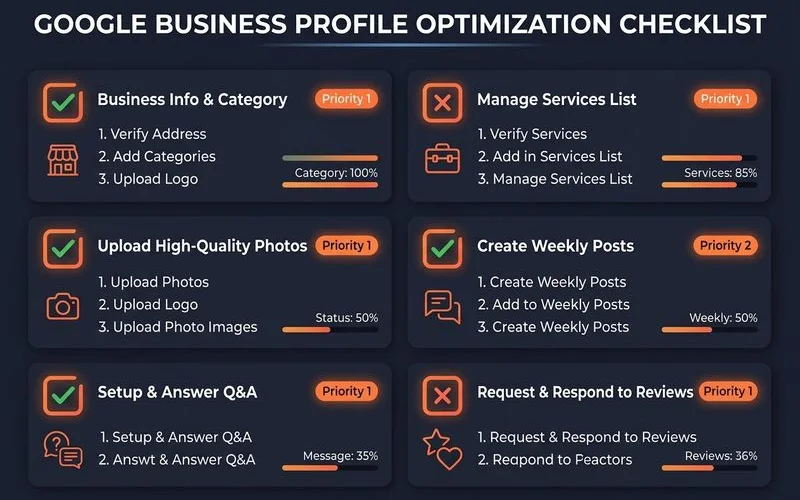
A Google Business Profile isn’t a “set it and forget it” tool. Google rewards profiles that are active and consistently updated, as it signals that the business is open and engaged. Here are five activities to perform every month.
- Post weekly. Use the “Updates” feature to share offers, news, or event details. Each post typically stays visible for seven days. While it’s okay to miss a week here and there, aim for consistency. Businesses that don’t post at all are missing a key engagement signal.
- Upload 3-5 fresh photos. Real photos of your storefront, your team, your products, or work in progress will always outperform generic stock images. According to a Synup study, business listings with photos get 42% more requests for directions. Profiles with over 100 photos can get 520% more calls.
- Answer Q&As within 24 hours. Customers can ask questions directly on your profile. Answering them quickly is essential. You can also pre-emptively add your own questions and answers to create a helpful FAQ section. This content often appears directly in your main business panel on Google.
- Respond to reviews within 48 hours. This applies to both positive and negative feedback. Research shows that 95% of consumers in Malaysia read online reviews before visiting a business. A prompt, professional response shows you value customer feedback.
- Update services and offers seasonally. Keep your profile current with promotions for holidays like Hari Raya, Chinese New Year, or Deepavali. Add year-end sales or school holiday packages to show that your listing is actively managed.
Review acquisition that survives Google’s filter
Reviews are a massive factor for both ranking and for convincing a customer to click. According to local search experts, review signals are one of the most important factors for ranking in the local pack. The challenge is that Google’s filter has become incredibly aggressive at removing reviews it deems manipulative.
Since a major policy update in early 2026, Google now uses AI to detect suspicious patterns. Reviews from brand-new accounts, reviews left in sudden bursts, or reviews submitted from an IP address inside your business are often flagged and removed.
Here are three compliant tactics that work well for Malaysian businesses:
- Direct review request via WhatsApp after service completion. Send a personalised message with your direct GBP review link shortly after a successful transaction. The conversion rate is highest when the request is sent the same day.
- QR code at point of sale. A simple QR code printed on a receipt, a business card, or a small sign at your counter makes it easy for happy customers to leave a review on their own phones, using their own data connection.
- Follow-up email sequence. An automated email sent 3-7 days after a purchase or service is another effective method. Crucially, stagger these emails. Sending a bulk request to your entire customer list at once is a classic red flag that can trigger Google’s spam filters.
What doesn’t work anymore? Offering discounts or gift cards for reviews, using SMS blasts for bulk requests, or using any service that pays people for reviews. These practices are explicitly forbidden and can lead to your listing being suspended.
Bilingual EN/BM NAP consistency
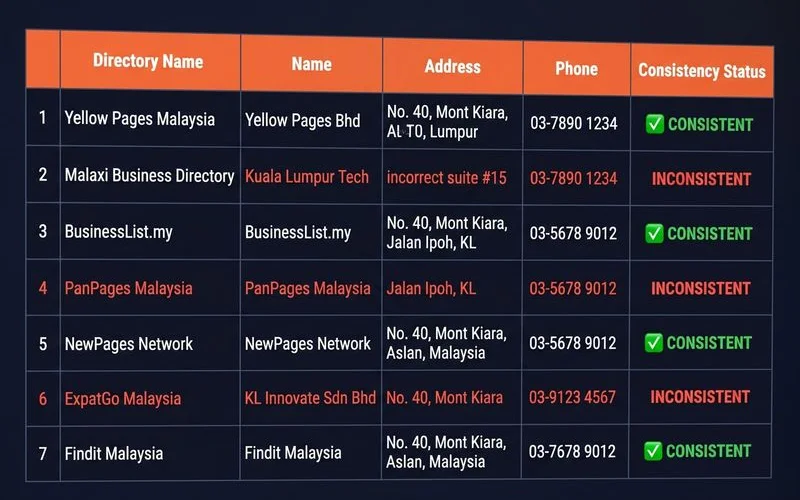
This is a detail where many local SEO efforts in Malaysia fall apart. Google often indexes the English (EN) and Bahasa Malaysia (BM) versions of business information separately. If your Name, Address, and Phone number (NAP) are inconsistent between these two versions, it creates conflicting signals that erode Google’s trust in your data.
Follow these three rules for bilingual Malaysian businesses:
- Choose one official name and stick with it. If your business is “Klinik Pergigian Dr. Lim,” it should appear that way in both your English and BM citations. Don’t use “Dr. Lim’s Dental Clinic” on English directories and the BM name elsewhere.
- Ensure the address format is identical. Don’t abbreviate “Jalan” to “Jln” in one listing and spell it out in another. The building name, unit number, and postal code must match exactly across all platforms.
- Use a consistent phone number format. The international format (+60) is generally best for consistency across online directories, but the most important thing is to pick one format and use it everywhere.
Our team uses several tools to audit NAP consistency, including platforms like BrightLocal and Moz Local, which can scan numerous directories to spot these inconsistencies. We cover this process in more detail in our citations and NAP consistency guide.
What we ship in a typical engagement
In the first month of working together, we conduct a complete audit of the existing Google Business Profile to check for completeness and identify any incorrect category selections. This process also includes a full NAP audit across more than 20 key Malaysian online directories to find and fix inconsistencies.
From the second month onwards, our work shifts to ongoing management. This retainer covers weekly posts, adding fresh photos, responding to reviews and questions, and running monthly geo-grid scans. These scans measure how your rankings are changing across different parts of your service area, giving us a clear picture of your visibility.
Want this run for your business? — Request a discovery call.
Quick Answers
How often should I post to my Google Business Profile?
Should I respond to negative reviews?
Can I have multiple GBP listings for different services?
Related Guides
How to Rank in the Google Map Pack (2026 Local SEO Playbook)
The 3 local-pack ranking factors (relevance, distance, prominence), why you appear in some searches but not others, and the practical playbook to win the 3-pack.
Local Citations and NAP Consistency for Malaysian Businesses
Top Malaysian local directories, the NAP-consistency audit we run on every Local SEO retainer, and how to clean up legacy listings that hurt your map-pack rankings.
Local SEO for Multi-Location and Service-Area Businesses
Location-page architecture, service-area vs storefront listings, when to use one GBP vs multiple, and the duplicate-content traps every multi-location business hits.
Local SEO vs Traditional SEO — Which Does Your Business Need?
When local SEO alone is enough, when traditional SEO matters, and how hybrid e-commerce-with-physical-store businesses split budgets between both.
Ready for the service?
Learn more about Local SEO Services
Map-pack visibility, Google Business Profile optimisation, and citation cleanup for Malaysian businesses serving local catchments.
Explore the Local SEO Service