
Local SEO vs Traditional SEO: Which Does Your Business Actually Need?
When local SEO alone is enough, when traditional SEO matters, and how hybrid e-commerce-with-physical-store businesses split budgets between both.
Last updated:

The core difference in one sentence
You can think of the distinction between local and traditional SEO as a focus on different types of customer intent.
Local SEO targets the Google 3-pack and ‘near me’ queries via Google Business Profile, local citations, and proximity signals. It’s for customers who need something now, and nearby.
Traditional SEO targets the blue-link organic results via topical authority, content depth, backlinks, and technical performance. This is for customers looking for information, products, or services without a geographic limitation.
Most Malaysian businesses need both, but the priority depends on your model. As an SEO agency founded by Adam Yong back in 2011, we’ve guided hundreds of businesses through this decision. Our Local SEO service and traditional SEO retainer share foundational work but emphasise very different signals to Google. If you’ve never broken down the local stack itself, start with our definition of Local SEO and then come back to compare it against traditional.
When Local SEO alone is enough
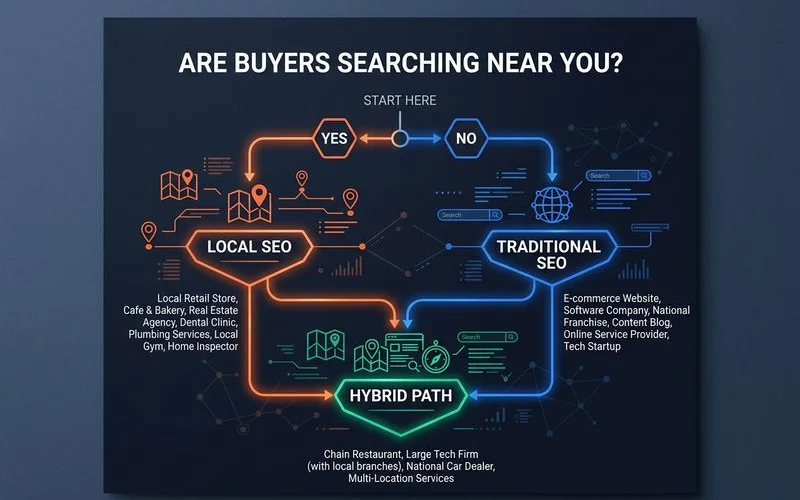
For some businesses, Local SEO is the primary investment and traditional SEO is a secondary consideration, if needed at all.
Single-location service businesses
A Bangsar dental clinic, a Mont Kiara hair salon, or a Petaling Jaya tutoring centre fit perfectly here. Their customers are searching for “[service] near me” or “[service] in Damansara.” Local SEO is designed to capture the vast majority of this high-intent search demand.
For these businesses, a fully optimised Google Business Profile (GBP) is the most critical asset. Features like Google Posts, a steady stream of positive reviews, and accurate NAP (Name, Address, Phone) information across the web are key ranking factors.
Service-area businesses with no online sales
Consider a KL-based air-con repair service, a home cleaning provider in Penang, or an electrician in Johor Bahru. Customers find them through Google Maps or the local pack results when they have an urgent need. Their website’s main job is to convert these local visitors with clear contact information and service details, not to rank for national keywords.
A key insight here is that the goal is often a phone call or a direct booking, not just website traffic.
Small B2B operators with a regional focus
An accounting firm serving the Klang Valley or an immigration consultant in Petaling Jaya has a geographically limited market. Investing heavily in ranking for nationwide terms often yields a low return. The focus should be on dominating local search results where their ideal clients are physically located.
For these businesses, our Local SEO at the Standard tier (RM 2,500/month) typically covers the essential foundation.
When traditional SEO matters
Three business types where traditional SEO is the primary investment and local is secondary.
National or international e-commerce
A Malaysian fashion brand like FashionValet selling across MY, SG, and ID is a prime example. Another is a B2B SaaS company targeting buyers across Southeast Asia. The customer’s location is irrelevant to the purchase, so broad topical authority and deep content are what secure top rankings. The Malaysian e-commerce market is projected to reach USD 12.18 billion in 2026, showing the massive potential here.
Content publishers and authority sites
Think of Malaysian financial news sites, lifestyle publications like Tatler Malaysia, or automotive content brands such as Paul Tan’s Automotive News. Their entire business model relies on ranking for a vast number of informational, long-tail keywords. Visibility in the local map pack is not a priority.
B2B SaaS and software businesses
Buyers in this space search for software categories (“CRM software”), comparison terms (“Xero vs QuickBooks Malaysia”), and feature-specific queries. Local intent is rarely a factor. The traditional “blue link” organic results are where over 90% of the clicks happen.
These businesses typically start at our Premium tier (RM 4,500/month) or higher. You can read our pricing guide for a tier-by-tier scope breakdown.
When you need both: A hybrid SEO strategy
This is where most growing Malaysian businesses find themselves. A hybrid model is essential for those with both a physical and a significant digital presence.
E-commerce with a retail presence
A fashion boutique in Bangsar that also ships nationwide needs a hybrid SEO strategy. The physical store requires Local SEO to appear in the 3-pack for local shopping queries. The website needs a strong E-commerce SEO strategy to rank its product pages for national searches. This approach caters to the “Research Online, Purchase Offline” (ROPO) behaviour seen in many consumers.
Multi-location services with online lead capture
A large clinic group with branches in KL, Penang, and JB is a perfect example. Each individual clinic needs its own Local SEO campaign to dominate its respective city’s search results. At the same time, the parent brand needs traditional SEO to rank for informational health-related articles that attract potential clients from all over Malaysia, feeding the top of the sales funnel.
B2B with both local and national clients
Consider a KL law firm that serves local SMEs while also offering specialised online legal services to clients across the country. Local SEO is vital for capturing the immediate, high-value local client pipeline. Traditional SEO helps build a national reputation and attract clients for its remote services.
Budget split when running both
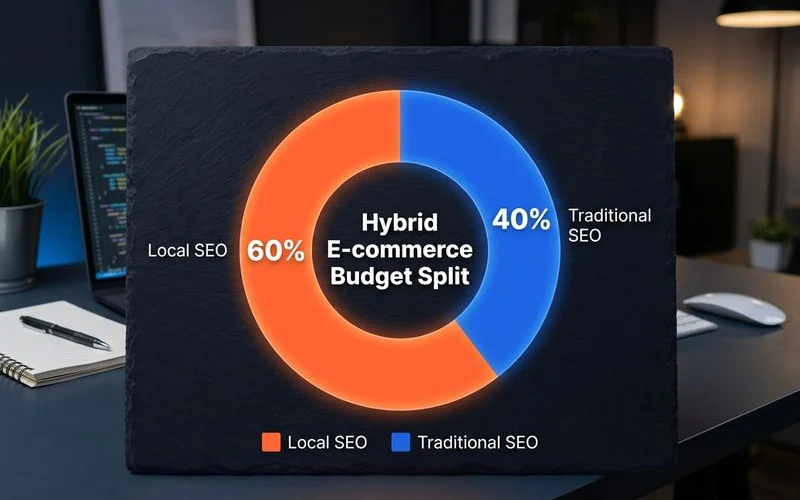
For hybrid Malaysian businesses, we recommend a phased budget allocation to maximise returns.
- Months 1-6: 60% Local SEO / 40% Traditional SEO. Local SEO often delivers results faster, sometimes within 3-6 months, because Google can quickly verify signals like your address and customer reviews. We prioritise these quick wins while the traditional SEO strategy builds authority in the background.
- Months 6-12: 50/50 Split. By this stage, the local rankings have compounded and started to stabilise. The traditional SEO efforts, which can take 6-12 months to show significant results, begin to produce measurable ranking improvements.
- Months 12+: 40% Local SEO / 60% Traditional SEO. Local SEO transitions into a maintenance phase to defend rankings. The budget majority then shifts to traditional SEO, which becomes the primary engine for new growth and market expansion.
This allocation assumes the business has the budget for a hybrid SEO strategy. Many clients start with one discipline and add the second after establishing a solid foundation over 6-12 months.
Migration paths as the business scales
Businesses evolve, and so should their SEO strategy. Here are two common growth patterns we manage.
From single-location service to national e-commerce
We start with a strong Local SEO focus. Around the 6-9 month mark, once local visibility is stable and driving consistent leads, we introduce traditional SEO. This involves creating in-depth content targeting national keywords. By the end of the first year, the budget typically shifts from being local-dominant to a balanced hybrid approach.
From pure e-commerce to adding a retail presence
The journey begins with a robust traditional SEO strategy to build national brand authority. The moment a retail location is secured, we layer on a targeted Local SEO campaign for that specific city. This includes an immediate Google Business Profile setup, citation building, and creating a geo-targeted landing page. For this model, both SEO types run in parallel from day one of the retail launch.
Want a tailored Local vs. traditional split for your business? Our team can help clarify the best path forward. We recommend you Request a discovery call.
Quick Answers
Can I switch from one to the other later?
Is there overlap in deliverables?
Which is cheaper to start?
Related Guides
Google Business Profile Optimization for Malaysian Businesses
Full GBP playbook for Malaysian businesses: category selection traps, photo/post cadence, review acquisition tactics, and the bilingual NAP-consistency mistakes to avoid.
How to Rank in the Google Map Pack (2026 Local SEO Playbook)
The 3 local-pack ranking factors (relevance, distance, prominence), why you appear in some searches but not others, and the practical playbook to win the 3-pack.
Local Citations and NAP Consistency for Malaysian Businesses
Top Malaysian local directories, the NAP-consistency audit we run on every Local SEO retainer, and how to clean up legacy listings that hurt your map-pack rankings.
Local SEO for Multi-Location and Service-Area Businesses
Location-page architecture, service-area vs storefront listings, when to use one GBP vs multiple, and the duplicate-content traps every multi-location business hits.
Ready for the service?
Learn more about Local SEO Services
Map-pack visibility, Google Business Profile optimisation, and citation cleanup for Malaysian businesses serving local catchments.
Explore the Local SEO Service