
What Is Local SEO — and Why It's Not the Same as Traditional SEO
Local SEO explained: the 3-pack vs blue links, Google's local algorithm signals (proximity, prominence, relevance), and when your business needs each approach.
Last updated:

You know how some marketing efforts feel like shouting into a void, while others connect directly with customers ready to buy? That’s the core difference between traditional and local SEO.
Many Malaysian business owners we speak to are experts at traditional SEO, focusing on broad authority. But they often miss out on high-intent customers in their own neighbourhood.
That’s where the distinction becomes critical. Recent data shows that 46% of all Google searches have local intent, meaning nearly half of searchers are looking for something nearby.
This guide will break down the practical differences, explain which approach your business needs, and outline how Google’s local algorithm actually works.
The definition
Local SEO is the practice of optimising a business’s online presence for location-based searches. These are queries like “car workshop in Shah Alam,” “best nasi lemak near me,” or “law firm Bangsar South.” It operates on Google’s local algorithm, which is a separate system from the one that ranks standard organic results.
It prioritises three signals that have little impact on traditional SEO: the completeness of your Google Business Profile, the consistency of your Name, Address, and Phone number (NAP) across online directories, and your physical proximity to the person searching.
Traditional SEO, in contrast, targets those familiar blue-link results below the map. Its success hinges on factors like in-depth content, high-quality backlinks, and overall website authority.
For most Malaysian businesses with a physical location or a defined service area, Local SEO often provides a quicker return on investment. The competition is confined to a specific geographic area, unlike the nationwide or global competition for broader keywords.
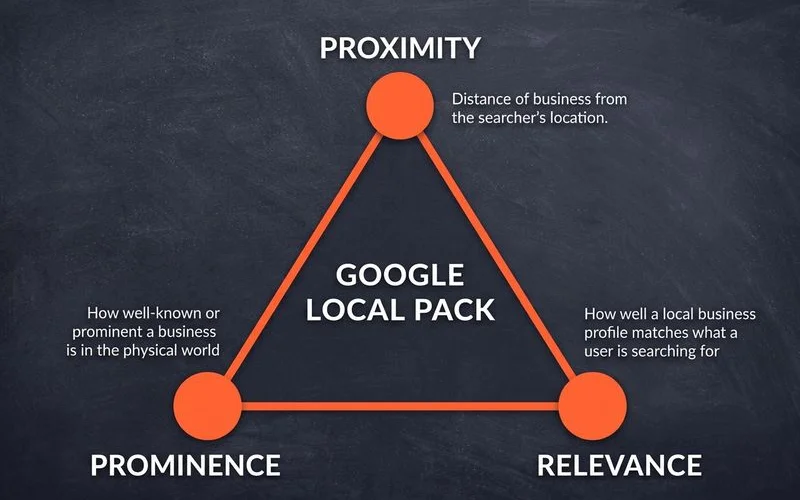
The three signals Google’s local algorithm weights
Google’s own documentation clearly identifies the three main factors that determine local search rankings.
- Relevance — This is how well your online profiles match a searcher’s query. It’s influenced by your primary category selection on Google Business Profile, the services you list, and your website’s content. A common mistake we see is a business choosing a broad category like “Restaurant” instead of the more specific “Nasi Kandar Restaurant,” which can dilute relevance. We explore this fully in our GBP optimisation guide.
- Distance — This measures how close your business is to the searcher’s physical location (or the location named in their search). It’s the reason you might rank number one for “cafe near me” when searching from your office, but not appear at all when searching from a few kilometres away.
- Prominence — This reflects how well-known and trusted your business is online. Google assesses this through signals like the quantity and quality of your Google reviews, consistent business listings (citations) on directories like PanPages and Yellow Pages Malaysia, and backlinks from other local websites. According to a 2025 study by Whitespark, a leading local SEO software company, review signals are a top-five ranking factor.
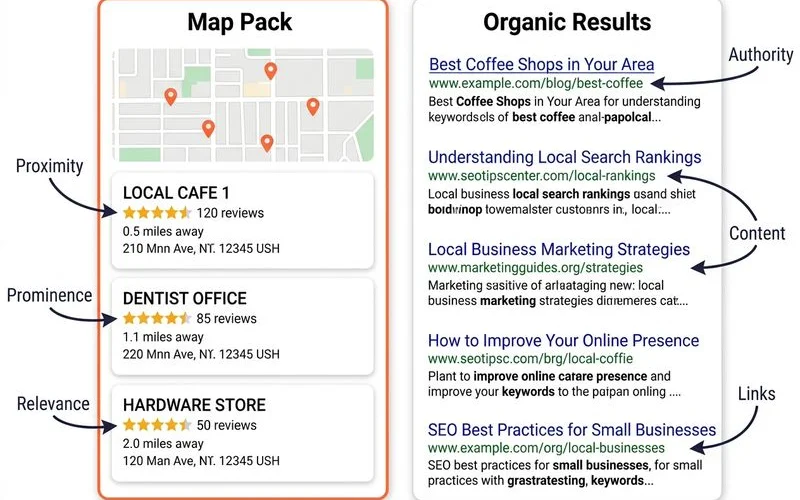
The 3-pack vs the blue-link results
When Google’s algorithm detects local intent in a search, it displays a special map-based result known as the “3-pack” or “local pack.” This box, usually appearing at the top of the page, shows three businesses with their location, ratings, and contact information.
For service-related queries, this 3-pack is incredibly valuable. Data from 2025 shows that the top three local pack positions capture a combined click-through rate of nearly 48%. This means they get almost half of all clicks for those searches.
Below the 3-pack, you’ll find the traditional blue-link organic results. These are ranked using the standard signals: content quality, backlinks, and website authority. The blue-link results are crucial for capturing informational queries that don’t trigger a map pack.
For example, a Malaysian dental clinic targeting “dental implant cost” wants to rank in the blue-link results. But for the query “dentist in Bangsar,” the primary goal is securing a spot in the 3-pack. Most local businesses need a strategy that targets both.
When you need local SEO vs traditional SEO
Deciding where to focus your efforts comes down to how and where your customers find you. Here’s a simple breakdown.
You need Local SEO if…
Your business serves customers within a specific physical area. If your customers use location-based terms like “near me” or name a city or suburb, Local SEO should be your primary focus. This applies to:
- Restaurants and cafes
- Clinics and law firms
- Home service providers (plumbers, electricians)
- Retail stores and workshops
You need traditional SEO if…
Your business operates without geographic boundaries, selling products or services nationally or globally. If you compete on broad informational topics rather than location, traditional SEO is essential. This is the main strategy for:
- E-commerce stores shipping nationwide
- Software as a Service (SaaS) companies
- Content publishers and affiliate sites
- B2B services with a national client base
You need both if…
Your business model is a hybrid. This is common for businesses that have a physical presence but also serve a wider audience online. For example, a retailer like MR.DIY needs Local SEO for its individual stores and traditional SEO for its main e-commerce website. Both strategies must work in parallel.
What Local SEO costs vs delivers
For a single location in a Malaysian city, a focused Local SEO retainer typically costs between RM 2,500 and RM 4,500 per month. More recent 2026 data shows that retainers can start from RM1,500 for less competitive areas and go up depending on the scope. A quality engagement at this price should always include Google Business Profile management, building local citations, on-page website optimisation, and performance reporting.
In terms of results, you can generally expect to see movement in the map-pack for lower-competition keywords within 8 to 16 weeks. For more competitive categories in major metro areas like Kuala Lumpur or Penang, achieving consistent 3-pack visibility often takes 4 to 6 months.
You can find a more detailed cost analysis in our SEO pricing guide.
Want to scope a Local SEO engagement for your business? Request a discovery call.
Quick Answers
Is local SEO cheaper than traditional SEO?
Do I need both Local SEO and traditional SEO?
Will Local SEO work for a service-area business with no storefront?
Related Guides
Google Business Profile Optimization for Malaysian Businesses
Full GBP playbook for Malaysian businesses: category selection traps, photo/post cadence, review acquisition tactics, and the bilingual NAP-consistency mistakes to avoid.
How to Rank in the Google Map Pack (2026 Local SEO Playbook)
The 3 local-pack ranking factors (relevance, distance, prominence), why you appear in some searches but not others, and the practical playbook to win the 3-pack.
Local Citations and NAP Consistency for Malaysian Businesses
Top Malaysian local directories, the NAP-consistency audit we run on every Local SEO retainer, and how to clean up legacy listings that hurt your map-pack rankings.
Local SEO for Multi-Location and Service-Area Businesses
Location-page architecture, service-area vs storefront listings, when to use one GBP vs multiple, and the duplicate-content traps every multi-location business hits.
Ready for the service?
Learn more about Local SEO Services
Map-pack visibility, Google Business Profile optimisation, and citation cleanup for Malaysian businesses serving local catchments.
Explore the Local SEO Service