
How to Rank in the Google Map Pack
The 3 local-pack ranking factors (relevance, distance, prominence), why you appear in some searches but not others, and the practical playbook to win the 3-pack.
Last updated:
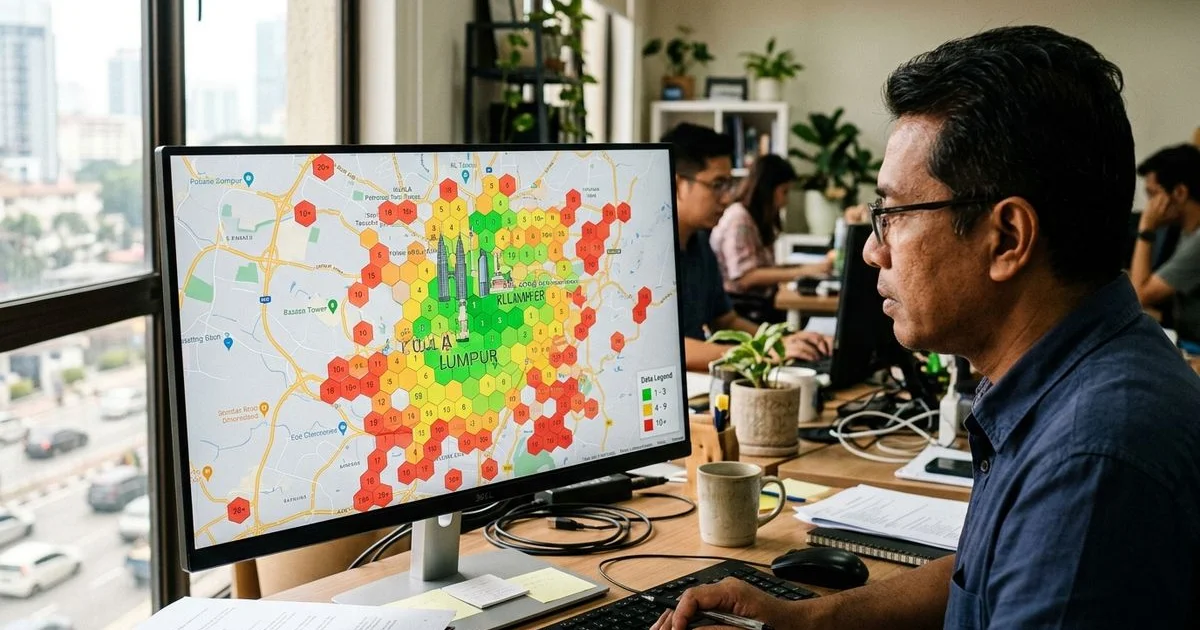
The 3-pack is the prize
You know how when you search for a local service, Google shows that little map at the top with three businesses? That’s the Google Map Pack, or “3-pack.”
It shows up whenever Google spots a local intention in a search, like “dental clinic Bangsar,” “plumber near me,” or “SEO agency KL.”
For a local business in Malaysia, getting into that box is everything. Recent data consistently shows the 3-pack gets a huge portion of the clicks, with some studies from SEO platform BrightLocal suggesting it can be as high as 44% of total clicks on the search results page.
Our entire Local SEO service is built to get our clients featured there. We do this by focusing on the three core ranking factors Google itself says it uses to decide who gets those top spots.
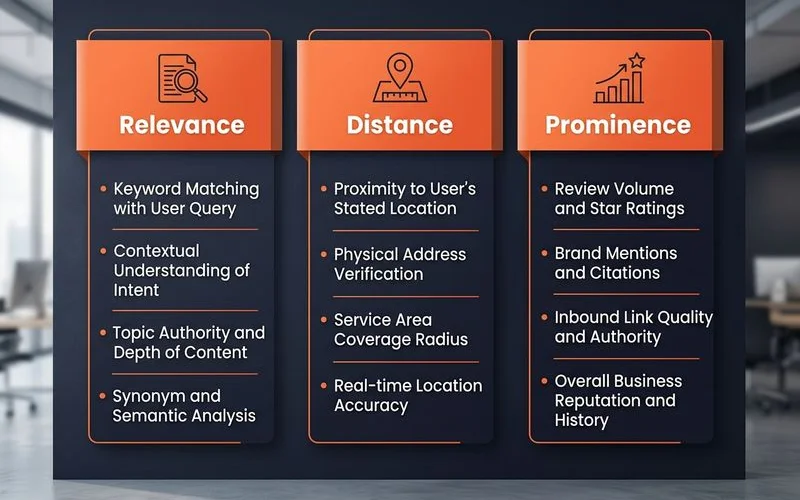
Google’s three local ranking factors
Google is surprisingly open about what matters for local search rankings. They group the signals into three main categories.
Each one has a number of smaller signals that you can directly influence.
Relevance — how well your business matches the searcher’s query
This is about proving to Google that you do what the searcher is looking for.
- Primary GBP Category: This is your most critical choice. Selecting “Nasi Lemak Restaurant” instead of the generic “Restaurant” can make a huge difference.
- Secondary GBP Categories: Add 5-10 supporting categories to capture related searches. A dental clinic might add “Cosmetic Dentist” and “Teeth Whitening Service.”
- Services Listed in GBP: Use the Services section to list every specific offering. Google sometimes shows these directly in your profile.
- Business Description and Attributes: Fill these out completely. Attributes like “Wheelchair accessible entrance” or “Halal food” can be deciding factors for customers.
- On-page Content: Your website needs pages that are relevant to the search. A page titled “Emergency Plumber in Cheras” sends a strong signal.
- Citation Consistency: Ensure your business category is listed consistently across directories like the Malaysia Yellow Pages.
Distance — how close your business is to the searcher
This factor is based on proximity, which Google calculates for every single search.
- Physical Address: The address on your Google Business Profile is the anchor point for storefronts.
- Service Area: For businesses that travel to customers, you define a service area instead of showing a physical address.
- Searcher’s Location: Google uses the searcher’s GPS data or the location they type into the search bar.
You can’t change your location, but you can overcome a distance disadvantage by being stronger in the other two areas.
Prominence — how well-known and trusted your business is
Prominence is Google’s measure of your authority and reputation, both online and offline.
- Google Reviews: The quantity and quality of your reviews are massive trust signals. A 2023 study by Whitespark found that reviews were the single most important factor for Map Pack ranking.
- NAP-Consistent Citations: Your business Name, Address, and Phone number (NAP) should appear consistently on quality local directories.
- Editorial Backlinks: Links from other websites to yours are a powerful vote of confidence.
- Website Domain Authority: This is a general measure of your website’s overall strength and trustworthiness.
- Branded Search Volume: When people search for your business name directly, it tells Google that you’re a known entity.
- Brand Mentions: Getting featured in respected Malaysian publications, even without a link, contributes to your prominence.
Why you rank in some searches but not others
Here’s a reality many business owners don’t see, your Google ranking changes based on where the search is performed.
A dental clinic in Bangsar might be #1 for a search made from inside Bangsar Village, but drop to #3 for someone searching from KLCC, and disappear entirely for a search from Petaling Jaya. This is the geo-grid reality.
Standard ranking tools often hide this by checking from a single, fixed postcode. This gives a misleading picture of your actual visibility. We use geo-grid tools like Local Falcon, which check your ranking from hundreds of different points across your target city. Every Adam SEO project starts with a geo-grid report to map out this real-world visibility.
So, how do you fix this distance problem and show up across a wider area?
You build overwhelming prominence. With enough positive reviews, strong citations, and genuine brand mentions, Google will see your business as an authoritative choice, even if another competitor is physically closer to the searcher.
The practical playbook to win the 3-pack
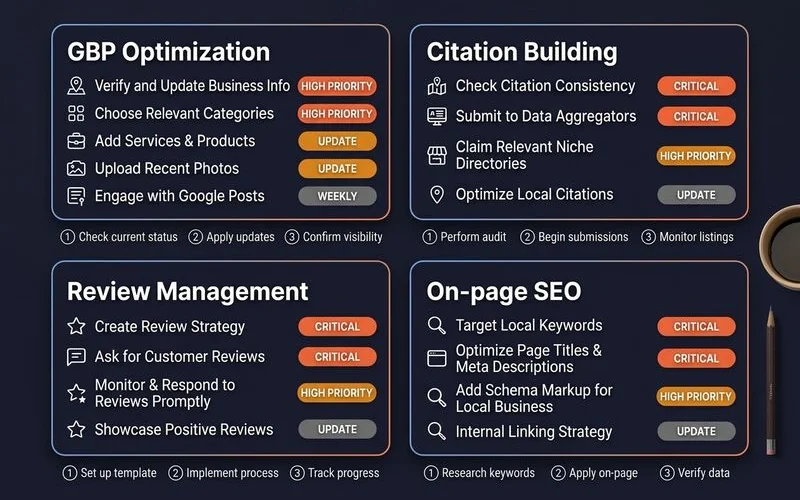
Here are the five core actions we implement for our clients to improve their Map Pack rankings, in order of priority.
1. Get GBP fundamentals right
Your Google Business Profile is the foundation. This means completely filling out every relevant section, your primary category, at least five secondary categories, all of your services, and uploading high-quality, recent photos. Don’t forget to use the Google Posts feature to share updates and answer questions in the Q&A section.
For a complete checklist, you can read our detailed GBP optimisation guide.
2. Build NAP-consistent citations
Citations are mentions of your business’s Name, Address, and Phone number on other websites. They need to be perfectly consistent everywhere they appear. We aim to build 20-40 citations on high-quality Malaysian directories and industry-specific sites.
Our guide to local citations walks through the exact workflow.
3. Maintain a review acquisition cadence
Reviews are the most powerful prominence signal you can actively influence. You need a steady stream of new, positive reviews. Aiming for 1-3 new reviews per week is a sustainable goal that signals ongoing customer activity to Google without triggering its spam filters. Using a tool to automate sending review requests can make this much more manageable.
4. Create geotargeted on-page content
Your website needs to support your local ranking goals. This means creating specific pages for your core services in your key locations. A page titled “Commercial Aircond Service in Shah Alam” with relevant local details will rank better than a generic “Our Services” page. These pages should include local schema markup and link to each other to build a strong internal network.
5. Earn editorial mentions on Malaysian publications
This is the most challenging but also the most defensible strategy. Earning 3-5 genuine mentions per quarter on real Malaysian news sites, popular blogs like Vulcan Post, or industry podcasts builds immense authority. This isn’t about paying for ads, it’s about earning real media coverage that cements your prominence.
Service Area Business vs storefront tradeoffs
When setting up your Google Business Profile, you have to choose between a storefront or a Service Area Business (SAB).
A storefront shows your physical address on the map. An SAB hides your address and shows a shaded service area instead.
The choice has a direct impact on how you rank.
| Feature | Storefront Listing | Service Area Business (SAB) |
|---|---|---|
| Best For | Businesses where customers visit a physical location (e.g., clinics, retail, restaurants). | Businesses that travel to the customer’s location (e.g., plumbers, cleaners, electricians). |
| Ranking Strength | Ranks very strongly for searches conducted very close to the physical address. | Can rank across multiple suburbs or a wider region, not tied to one specific point. |
| Common Use Case | A cafe in TTDI wants to attract foot traffic from the local neighbourhood. | An HVAC company based in Puchong wants to serve customers in Subang Jaya and Damansara. |
For most Malaysian B2B services, we recommend a hybrid approach. Use a storefront address but also define a service area to show the broader region you cover.
The 3-pack checklist we run on every engagement
Our process for improving Map Pack rankings is systematic and proven.
In the first month, we conduct a full GBP audit, run a baseline geo-grid report to see your actual visibility, and complete a thorough NAP audit to find all inconsistencies.
Months two and three are focused on execution. We deploy all the fixes to your GBP, clean up and build new citations, and help you implement a system for generating reviews consistently.
From month four onwards, the focus shifts to building long-term authority. This involves ongoing production of geotargeted content for your website, acquiring high-quality backlinks, re-scanning the geo-grid monthly to track progress, and re-auditing your NAP profile every quarter to ensure it stays clean.
Want this playbook executed for your business? Request a discovery call with us.
Quick Answers
Why am I in the 3-pack from my office but not from a neighbouring suburb?
How long until I'm in the 3-pack?
Does paid Google Ads affect my organic 3-pack ranking?
Related Guides
Google Business Profile Optimization for Malaysian Businesses
Full GBP playbook for Malaysian businesses: category selection traps, photo/post cadence, review acquisition tactics, and the bilingual NAP-consistency mistakes to avoid.
Local Citations and NAP Consistency for Malaysian Businesses
Top Malaysian local directories, the NAP-consistency audit we run on every Local SEO retainer, and how to clean up legacy listings that hurt your map-pack rankings.
Local SEO for Multi-Location and Service-Area Businesses
Location-page architecture, service-area vs storefront listings, when to use one GBP vs multiple, and the duplicate-content traps every multi-location business hits.
Local SEO vs Traditional SEO — Which Does Your Business Need?
When local SEO alone is enough, when traditional SEO matters, and how hybrid e-commerce-with-physical-store businesses split budgets between both.
Ready for the service?
Learn more about Local SEO Services
Map-pack visibility, Google Business Profile optimisation, and citation cleanup for Malaysian businesses serving local catchments.
Explore the Local SEO Service