
How to Get Your Brand Cited in ChatGPT, Gemini and Google AI Overviews
Practical playbook: structured-data signals, brand co-occurrence patterns, content formats LLMs prefer, and how to audit your existing AI citations today.
Last updated:

What it means to be cited
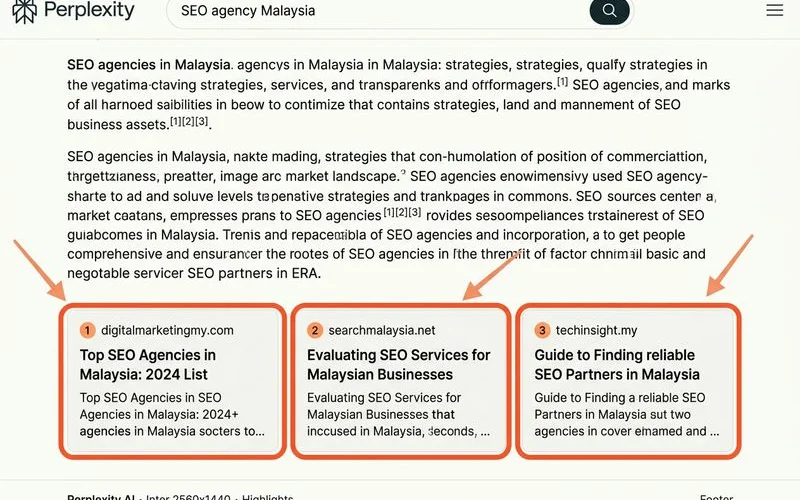
You’ve likely noticed how search is changing. When a user in Kuala Lumpur asks Perplexity, “Best digital marketing agency in Malaysia?” or asks ChatGPT, “How long does SEO take?”, the engine returns a direct answer, often listing specific brands and sources. Those sources are citations.
This is the new front line for visibility.
Recent data shows that AI-mediated searches will account for nearly two-thirds of all search interactions by 2027. For businesses in Malaysia, this is a critical shift. Citation share is the new ranking position. Brands that are consistently cited for queries defining their category will capture the attention of buyers early in their journey. Those that are not cited become invisible, no matter how well they rank in traditional Google results.
Our AEO/GEO service is designed specifically to solve this problem, moving your brand’s citation share from non-existent to dominant in the AI engines that matter most to your customers.
The four-layer playbook
Our approach is built on four layers of work that build on each other, typically delivering measurable results within three to six months.
Layer 1 — Structured data signals (fastest impact)
Schema.org markup is the clearest signal you can send to AI engines. It’s like giving them a neatly organised file about your business instead of a messy pile of documents. We prioritise three types of schema:
- Article schema on all editorial content, like blog posts and guides.
- FAQPage schema for any page that answers common questions, which includes most service and support pages.
- Organization schema on your homepage and About page to clearly define who you are.
Getting this layer right is crucial for clean, unambiguous parsing by AI engines. However, a common mistake is assuming the implementation is correct without verification. To avoid this, we use tools like the official Schema Markup Validator and Google’s Rich Results Test to confirm the code is error-free before deployment. You can find more details on how we handle this in our schema markup guide.
Layer 2 — Content format for extractability
Large Language Models (LLMs) favour content that is structured for easy extraction. We have found four formatting adjustments to be highly effective:
- Lead with the answer. The page should directly answer the user’s implied question in one to three sentences, right at the top.
- Use FAQ blocks. Structure content with H2 or H3 headings phrased as questions, followed by concise, one to three-sentence answers.
- Create step-by-step lists. Use numbered or bulleted lists for any procedural or “how-to” content. LLMs can extract and present this format cleanly.
- Define key terms. Use clear “X is Y” statements, which is especially important for informational queries that define a category.
Following Google’s own “helpful content” guidelines is the key here. The goal is to avoid long, rambling introductions and get straight to the point. Engines will often skip or cut off content that takes too long to provide an answer.
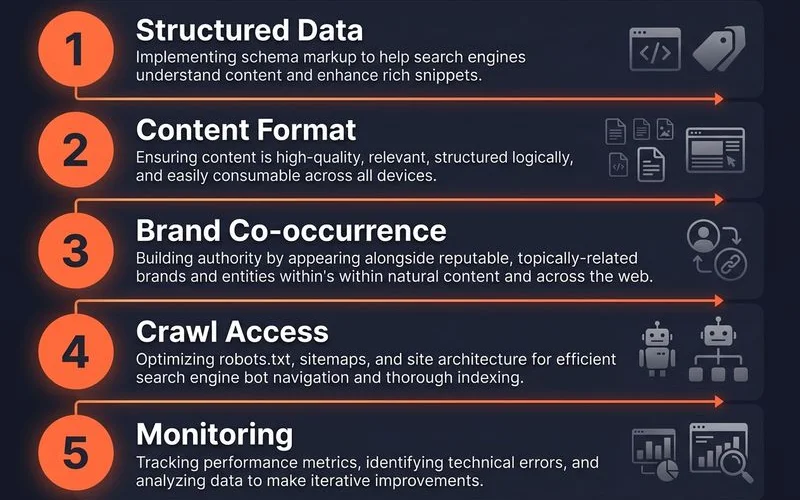
Layer 3 — Brand co-occurrence (slowest, most defensible)
This is the layer that builds a long-term, defensible advantage. LLMs decide which brands to cite by learning how often a brand name appears alongside category-defining terms across many authoritative sources. Three tactics work best:
- Editorial placements. We aim for placements in top-tier Malaysian publications like The Edge Malaysia, The Star Business, and Business Today. Each mention helps establish the connection between your brand and your category.
- Podcast appearances. Having founders or key team members appear on relevant podcasts adds another layer of co-occurrence signals to the AI’s training data.
- Authority-site mentions. Placements on industry association sites, partner case studies, and even a Wikidata entry all reinforce your brand’s entity and its association with your industry.
The impact of this work starts to become visible around the fourth month and builds significantly over time. Brands that consistently invest in this layer for a year often become dominant in their category’s LLM citations.
Layer 4 — AI crawler access management
You cannot be cited if the AI engines can’t see your content. It’s a simple but often overlooked technical step. This is managed in a file in your site’s root directory called robots.txt. We ensure our clients allow access to the essential crawlers:
- GPTBot (OpenAI’s training crawler)
- ChatGPT-User (OpenAI’s live fetcher for user requests)
- Google-Extended (Google’s AI training crawler)
- PerplexityBot (Perplexity’s crawler)
- anthropic-ai / ClaudeBot (Anthropic’s crawlers)
Some businesses block these bots to protect their content from being used in AI training. For any company pursuing AI visibility, however, blocking them is counterproductive. For platforms like Cloudflare, this can often be managed through their dashboard, which provides specific toggles for AI bot traffic.
How to audit your existing AI citations
Here is a straightforward process you can use to check your current visibility:
- Choose 10-15 queries that are important to your business. Include branded searches like “[your brand] reviews” and category searches like “best accounting software Malaysia.”
- Run each query across ChatGPT, Gemini, and Perplexity. Also, check for Google AI Overviews. According to a 2026 report, these engines represent the vast majority of the AI search market.
- Create a simple spreadsheet to document where you are cited, for which queries, and in what position.
- Note which competitors are cited when your brand is not.
- Repeat this audit every quarter to track your progress.
Our DIY AI-visibility audit guide provides a more detailed walkthrough. For our retainer clients, we conduct this audit monthly as a core part of our reporting.
What we do for clients on Premium and Elite
Our process is structured and transparent.
In the first month, we complete a baseline citation audit and implement the necessary schema markup across your site’s templates. During months two and three, our focus shifts to reformatting the content on your top 10-20 most important pages for better extractability. From the fourth month onwards, we build out an editorial placement pipeline and perform quarterly re-audits of your citation share.
Most of our client engagements show measurable growth in citation share in at least two of the major AI engines by the six to nine-month mark.
Want this run for your business? — Request a discovery call.
Quick Answers
How long until I see citations?
Do paid mentions help with AI citations?
Should I block GPTBot or allow it?
Related Guides
AI Search vs Traditional Google Search — What's Changing in 2026
Zero-click trends, the share of search shifting to AI engines, what stays the same (intent matching), what changes (citation > ranking), and how to split your budget.
Is Your Brand Visible to AI? How to Audit AI Visibility
DIY AI-visibility self-audit checklist: search your brand in ChatGPT/Gemini/Perplexity, what good vs bad looks like, and what to do when you're not being cited.
Schema Markup and Structured Data for AI Search Engines
Which schema types matter most for AI engines (Article, FAQ, HowTo, Organization), working JSON-LD examples, validation tools, and the implementation errors we see weekly.
What Is AEO (Answer Engine Optimization)?
AEO defined: how Answer Engine Optimization differs from traditional SEO, which engines it targets, and what an AEO-optimised page actually looks like.
Ready for the service?
Learn more about AEO & GEO — AI Search Optimization
Audit and improve your brand's visibility inside ChatGPT, Gemini, Perplexity, and Google AI Overviews — the new front door of organic search.
Explore the AEO / GEO Service