
AI Search vs Traditional Google Search: What's Actually Changing in 2026
Zero-click trends, the share of search shifting to AI engines, what stays the same (intent matching), what changes (citation > ranking), and how to split your budget.
Last updated:

The honest picture of where search is in 2026
You know how the conversation around search has completely changed in the last couple of years. It feels like two very different things are true at the same time, and our data confirms they are.
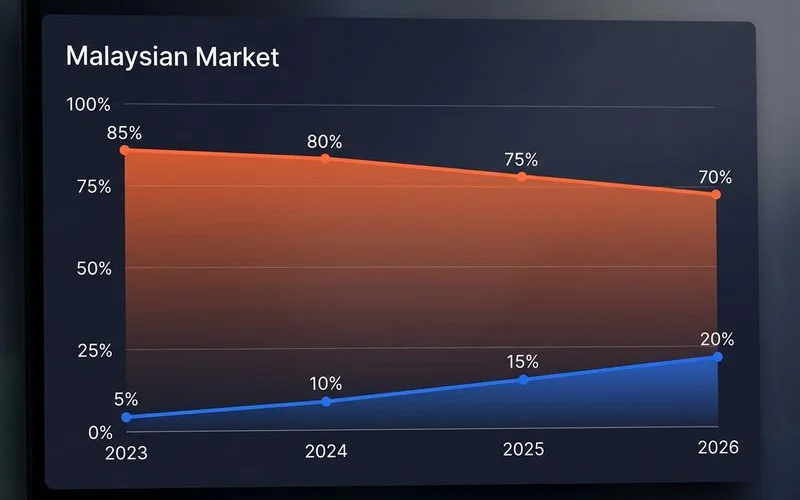
First, Google is still the main player. According to StatCounter, Google holds over 92% of the search engine market share in Malaysia as of April 2026. The sheer volume of searches happening on Google’s platforms, including web, image, and maps, has not gone away. If your brand is invisible in Google’s traditional blue-link rankings, you are still invisible to most of your potential customers.
Second, AI search is a real and rapidly growing force. A January 2026 study by Vodus Research found that 67% of Malaysians have used an AI tool recently. Tools like ChatGPT, Gemini, and Perplexity are capturing a significant slice of queries that once belonged only to Google. A separate report notes that Perplexity usage among Malaysian professionals grew 340% through 2025 alone.
The strategic path forward is clear: you need to invest in both layers. For our perspective on the AI side of things, you can read our AEO/GEO service page. To build the essential foundation that supports both, see our 4-Stage Framework.
What’s actually changing
Three major shifts are defining SEO strategy right now, and we see them in our clients’ analytics every day.
1. Zero-click results are taking over
Google’s AI Overviews, featured snippets, and knowledge panels are designed to answer questions directly on the search results page. This means fewer people need to click on the traditional blue links. Studies from 2026 show that informational queries are the hardest hit, with some analyses reporting click-through-rate drops of 20% to 40% when an AI Overview is present.
2. Citation share is the new ranking position
In the world of AI search, being mentioned as a source is often more valuable than a number one ranking. It is great to rank first in Google for a term like “how to start an e-commerce business,” but it is arguably more powerful to be cited as the authority in the AI-generated answers on ChatGPT and Perplexity. According to a recent Vodus Research report, this is where a lot of initial research now begins, though 78% of Malaysians still use Google to verify AI-generated information.
3. Long-tail informational queries are moving to AI
Questions like “how does compounding interest work?” or “what is the best camera for beginners?” are increasingly being asked to AI engines. These tools can synthesise information from multiple sources to provide a comprehensive answer, which many users find more efficient than reviewing ten separate blue-link results.
What stays the same
Despite all the changes, the core principles of good SEO have not been thrown out. Three things remain constant.
Intent matching. Every search engine, from Google to Gemini, is trying to understand the user’s underlying goal and deliver content that satisfies it. The signals that demonstrate you have met that intent, such as topical authority and clear, in-depth content, are equally effective for ranking in blue-link results and getting cited by AI.
Content quality. Both traditional search engines and AI models reward content that is clear, accurate, and genuinely useful. Google’s quality framework, known as E-E-A-T (Experience, Expertise, Authoritativeness, and Trustworthiness), is now a baseline for AI visibility. While Google’s algorithm ranks entire pages, AI engines often extract specific, answer-focused passages, but the standard for quality is the same.
Brand authority. Brands that are recognised as topical authorities get the best of both worlds. They rank well in Google and are frequently cited by AI engines. The signals for authority overlap significantly, including editorial coverage in respected publications, citations on other authoritative websites, and strong brand search volume.
What changes for strategic emphasis
With this new landscape, how we allocate our efforts needs to adjust. We’re prioritising three key areas in our client work.
1. Schema becomes critical, not just a nice-to-have
In the past, implementing schema markup was often a lower-priority task. Now, it is essential. AI engines rely heavily on this structured data to extract information accurately and confidently. Investing in comprehensive schema, which you can learn about in our guide to schema markup for AI search, has moved from a “Stage 3” task to a day-one priority for every project we undertake. Key types like LocalBusiness, Product, and FAQPage are particularly impactful.
2. Content format matters more than content length
The old SEO habit of writing longer articles to rank better is no longer effective on its own. A concise 600-word article that is structured for easy extraction can perform much better than a 2,400-word essay. We now focus on creating content with clear, single-sentence answers, answer-first paragraphs, and well-structured FAQ sections. This format is what AEO (Answer Engine Optimisation) and GEO (Generative Engine Optimisation) are all about.
3. Brand co-occurrence is a top-tier signal
Getting your brand mentioned in reputable, tier-one publications has always been important. In the age of AI search, it is even more so. Large Language Models (LLMs) directly analyse these co-occurrence patterns when deciding which brands to cite as authoritative sources. This makes strategic digital PR, aimed at securing features in trusted local media like The Star or Vulcan Post, a core component of building authority.
The recommended 2026 budget split
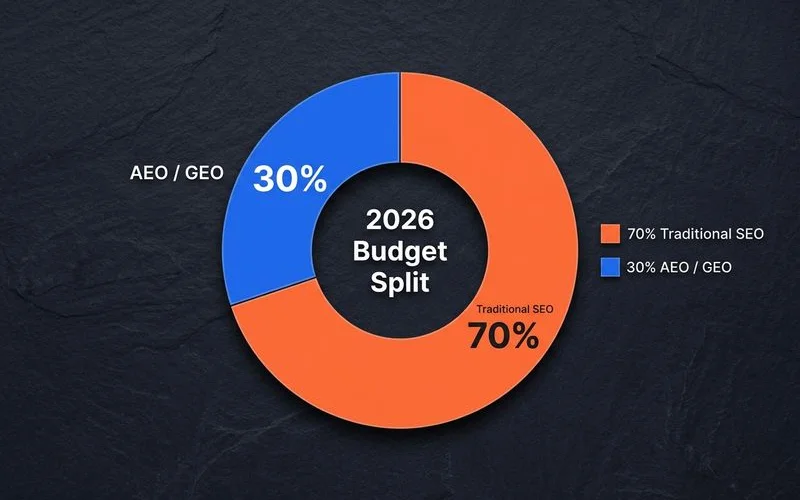
For most of the Malaysian businesses we work with, we recommend the following allocation:
- 70% traditional SEO: This covers the foundational work of improving blue-link rankings, on-page optimisation, link acquisition, and ensuring technical health with things like Core Web Vitals. For local businesses, this also includes optimising for Google’s map pack.
- 30% AEO/GEO: This portion is dedicated to ensuring your content is ready for AI. It includes expanding schema coverage, reformatting content for extractability, tracking AI citations, and actively working on brand co-occurrence through digital PR.
Within that 30% for AEO/GEO, we typically suggest a 60/40 split. About 60% goes to AEO, which you can learn about in our guide to Answer Engine Optimisation, as it provides faster feedback. The remaining 40% is for GEO, detailed in our guide to Generative Engine Optimisation, which compounds more slowly over time.
When the ratio should shift
This 70/30 split is a starting point, not a rigid rule. We advise shifting more budget towards AEO/GEO under two conditions.
Your category is heavy on informational research. This applies to fields like B2B SaaS, professional services such as law or accounting, healthcare information, and financial advice. In these areas, buyers conduct extensive research before making a decision, and AI engines are increasingly the platform for that research. A shift towards a 60/40 or even a 50/50 split often makes sense here.
Your brand has weak traditional rankings but strong category authority. Some businesses have a strong reputation offline or within their industry but have never ranked well in Google. For these brands, it can be faster to build AI citation share than to climb the traditional blue-link rankings. AEO/GEO investment can compound on existing authority signals to deliver visibility more quickly.
For brands that have weak authority overall, traditional SEO must come first. An investment in AI optimisation without a solid foundation will not produce meaningful results.
If you are unsure about the right budget split for your business, we can help. Request a discovery call and we can build a custom plan together.
Quick Answers
Is traditional SEO dying?
Should I divert ad budget to AI search?
What's the right budget split between traditional SEO and AEO/GEO?
Related Guides
Is Your Brand Visible to AI? How to Audit AI Visibility
DIY AI-visibility self-audit checklist: search your brand in ChatGPT/Gemini/Perplexity, what good vs bad looks like, and what to do when you're not being cited.
How to Get Cited in ChatGPT, Gemini and Google AI Overviews
Practical playbook: structured-data signals, brand co-occurrence patterns, content formats LLMs prefer, and how to audit your existing AI citations today.
Schema Markup and Structured Data for AI Search Engines
Which schema types matter most for AI engines (Article, FAQ, HowTo, Organization), working JSON-LD examples, validation tools, and the implementation errors we see weekly.
What Is AEO (Answer Engine Optimization)?
AEO defined: how Answer Engine Optimization differs from traditional SEO, which engines it targets, and what an AEO-optimised page actually looks like.
Ready for the service?
Learn more about AEO & GEO — AI Search Optimization
Audit and improve your brand's visibility inside ChatGPT, Gemini, Perplexity, and Google AI Overviews — the new front door of organic search.
Explore the AEO / GEO Service