
Is Your Brand Visible to AI? Here's How to Audit AI Visibility
DIY AI-visibility self-audit checklist: search your brand in ChatGPT/Gemini/Perplexity, what good vs bad looks like, and what to do when you're not being cited.
Last updated:

Why baseline now
You’ve probably noticed that search results are changing. AI-generated answers now sit at the top of the page, and your customers are using them. In fact, a 2025 Google report noted that three out of four Malaysian digital consumers have already used generative AI tools for research.
This shift is why a baseline AI visibility audit is so critical. Most Malaysian brands we work with have never checked how they appear in AI. A quick, 30-minute DIY audit usually uncovers two surprises: the brand is invisible in categories it should dominate, and competitors are getting cited in valuable queries the brand didn’t even know mattered.
Running this baseline now is crucial. Fixing AI visibility issues, which involves what we call AEO/GEO work, typically takes 3-6 months. The sooner you measure your visibility, the sooner you can implement the necessary fixes to be seen.
The 30-minute DIY workflow
Here is a straightforward, five-step process. We recommend having a notebook or a spreadsheet open to track your findings.
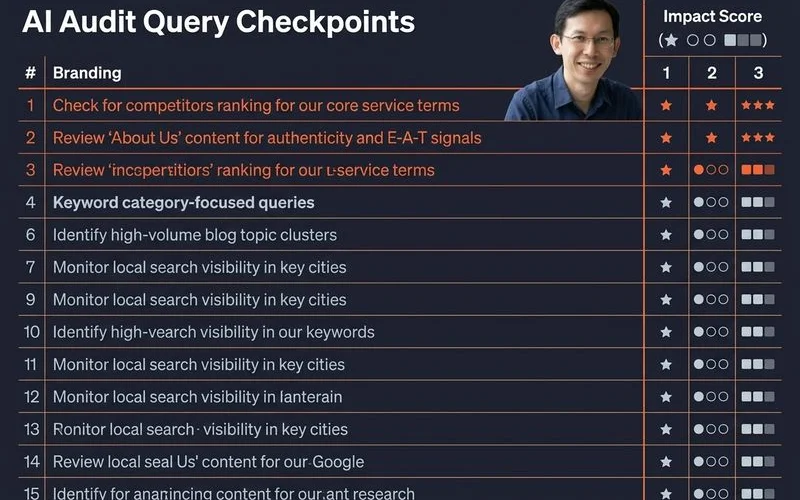
Step 1 — Pick 15 queries across three categories
Five branded queries. These are direct mentions of your business name.
- “What is [your brand]?”
- “[Your brand] reviews”
- “Is [your brand] good for SMEs?”
- “[Your brand] vs [competitor]”
- “[Your brand] pricing in Malaysia”
Five category queries. These are searches where customers are looking for a business like yours without naming you.
- “Best [category] in Malaysia”
- “Top [category] agencies in Kuala Lumpur”
- “[Category] for retail businesses”
- “Affordable [category] services for startups”
- “[Category] vs [adjacent category] comparison”
Five informational queries. These are topic-based questions your potential customers ask.
- “How does [category service] work?”
- “How much does [category] cost in Malaysia?”
- “How long does [category] take to see results?”
- “[Category] mistakes to avoid for new businesses”
- “[Common pain point in your category] solutions”
Step 2 — Run each query across four engines
To get a comprehensive view, test each query on the primary AI engines used by Malaysian customers.
- ChatGPT: Use the official chatgpt.com site, preferably with the web-browsing mode enabled to ensure it pulls the latest information.
- Google Gemini: Access this through gemini.google.com.
- Perplexity: Use perplexity.ai. This engine is particularly useful because it clearly cites its sources, giving you direct insight into what content the AI trusts.
- Google AI Overviews: Search your query on google.com and see if an AI-generated summary appears at the top. These overviews now feature in over 30% of search results.
For broader coverage, you can also include Microsoft Copilot, which is another significant player in the AI search space.
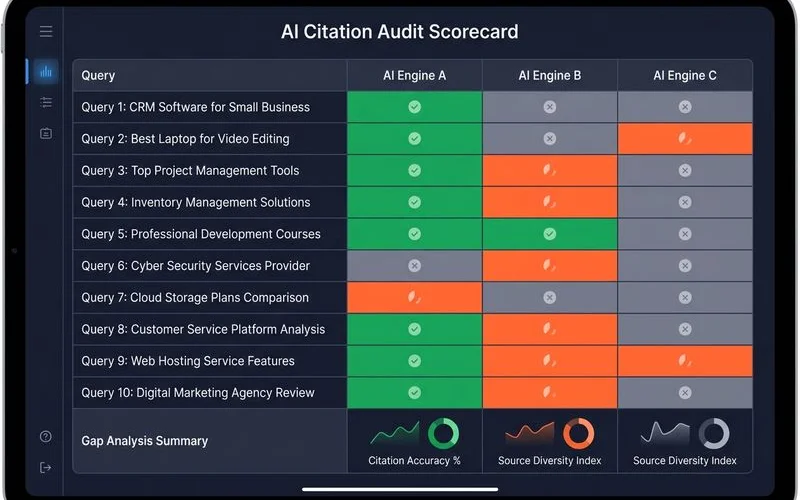
Step 3 — Score each result
For every query and engine combination, assign a score based on how your brand is represented. Being consistent is key.
| Score | Meaning | Example |
|---|---|---|
| 0 | Invisible | Your brand is not mentioned at all. |
| 1 | Minor Mention | Your brand is mentioned in a list but not as a top recommendation. |
| 2 | Primary Citation | Your brand is cited as a primary source, often with a link. |
| 3 | Lead Source | Your brand is the top recommendation, positioned prominently. |
Step 4 — Document the gaps
For any query where you scored a 0 or 1, take detailed notes. This analysis is the most valuable part of the audit.
- Identify the winner: Which competitor was cited instead of you?
- Analyse the source: What did the cited content actually say? Was it accurate?
- Note the format: Was the source a detailed blog post, a simple FAQ page, a service page, or a third-party review site?
Knowing precisely why a competitor earned the citation tells you exactly what kind of content or authority signal you need to build.
Step 5 — Calculate the score
Finally, add up your scores from all 60 query and engine combinations (15 queries x 4 engines). The maximum possible score is 180. In our experience auditing local businesses, most score between 15 and 40 before any targeted AEO work. Brands with a strong, established AEO/GEO strategy typically score above 80, while true category leaders exceed 120.
What good vs bad looks like
Excellent (score 120+). Your brand is consistently cited for branded queries, appears frequently for category queries, and is present in relevant informational queries. This is the ideal state for AEO/GEO, demonstrating defensible authority in your category.
Healthy (score 60-120). Branded queries reliably bring up your brand. You appear in some category queries, but informational queries rarely cite you. Most Malaysian SMEs we’ve worked with land here after about 6 to 12 months of focused AEO/GEO investment.
Vulnerable (score 30-60). Your brand is only cited for direct branded queries. You’re absent from category-level searches. This is the default for most Malaysian businesses that haven’t yet invested in their AI visibility.
Invisible (score under 30). The AI struggles to find your brand even when searched by name. This often indicates a weak overall web presence or entity confusion, where the AI mistakes your brand for another. Fixing this level of invisibility is a significant 6 to 12-month investment.
What to do when you’re not being cited
Your score will determine the right level of intervention.
Score 80+. You’re in a strong position, so the focus is on maintenance. Continue to add one or two new pillar content pieces each quarter to reinforce your authority. We recommend monitoring your scores quarterly to defend against new competitors.
Score 30-80. This requires active investment. It’s time to ship the foundational AEO work. This includes implementing specific schema markup (like Organization and FAQ schema) across your website templates, reformatting your top 10-20 pages for clarity, and adding FAQ sections that directly answer customer questions. You should also begin editorial outreach to build brand mentions on trusted third-party sites.
Score under 30. This calls for a diagnostic review before a full rebuild. You’ll need to audit your site’s technical SEO foundation, define your brand entity clearly on platforms like Wikidata and LinkedIn, and review your existing press coverage. A material change from this starting point often requires a 9 to 12-month timeline.
When DIY isn’t enough
This DIY audit is perfect for establishing a baseline. However, manual tracking becomes tedious and time-consuming if you want to monitor progress monthly.
Our team has developed an internal AI visibility tracker that automates this entire process. It queries the engines, scores the citations against your competitors, and tracks your visibility trends over time. This tool is included with every Premium and Elite tier retainer we offer.
Want the full audit run by Adam Yong personally? — Request a discovery call, or see our June 2026 free audit clinic post.
Quick Answers
How many queries should I test?
What if my brand is cited but inaccurately?
Do I need any paid tools to run this audit?
Related Guides
AI Search vs Traditional Google Search — What's Changing in 2026
Zero-click trends, the share of search shifting to AI engines, what stays the same (intent matching), what changes (citation > ranking), and how to split your budget.
How to Get Cited in ChatGPT, Gemini and Google AI Overviews
Practical playbook: structured-data signals, brand co-occurrence patterns, content formats LLMs prefer, and how to audit your existing AI citations today.
Schema Markup and Structured Data for AI Search Engines
Which schema types matter most for AI engines (Article, FAQ, HowTo, Organization), working JSON-LD examples, validation tools, and the implementation errors we see weekly.
What Is AEO (Answer Engine Optimization)?
AEO defined: how Answer Engine Optimization differs from traditional SEO, which engines it targets, and what an AEO-optimised page actually looks like.
Ready for the service?
Learn more about AEO & GEO — AI Search Optimization
Audit and improve your brand's visibility inside ChatGPT, Gemini, Perplexity, and Google AI Overviews — the new front door of organic search.
Explore the AEO / GEO Service