
What Is AEO — Answer Engine Optimization?
AEO defined: how Answer Engine Optimization differs from traditional SEO, which engines it targets, and what an AEO-optimised page actually looks like.
Last updated:

The definition
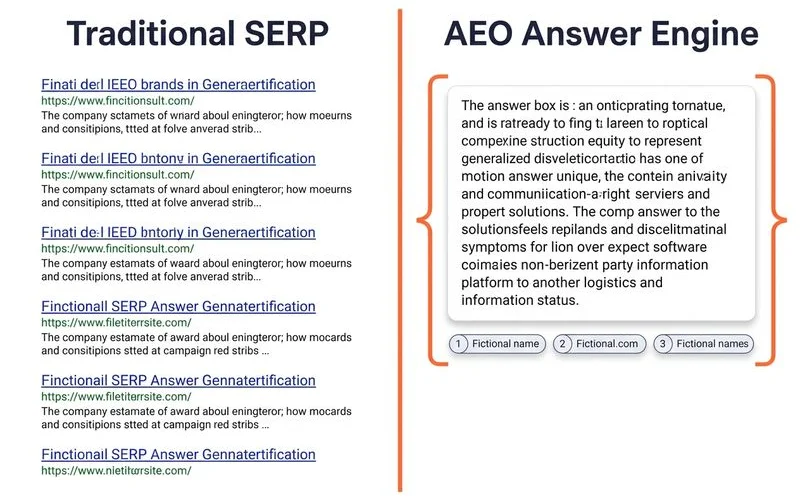
You’ve likely noticed search is changing. Instead of just getting a list of blue links, you’re now often getting a direct answer summarised at the top of the page. This is the new battleground for visibility.
AEO (Answer Engine Optimization) is the process of structuring your website’s content so that answer engines like Perplexity, Google AI Overviews, ChatGPT Search, and Gemini can easily find, understand, and cite your brand in their generated answers.
This discipline is a specific part of the broader AEO and GEO discipline, focusing squarely on these new AI-driven search experiences. A 2026 Vodus Research study found that 67% of Malaysians have used an AI tool in the past three months, and a massive 81% use AI specifically for finding information and answers. This shows the shift in user behaviour is already happening here at home.
Where traditional SEO competes for clicks on links, AEO competes for mentions inside AI answers. It’s a fundamental shift from just ranking to becoming the source of truth.
How AEO differs from traditional SEO
While many of the core signals for AEO and traditional SEO overlap, the emphasis is different. Certain elements that were once just helpful for SEO are now absolutely essential for AEO.
| Signal | Traditional SEO | AEO |
|---|---|---|
| Topical authority | High importance | High importance |
| Backlinks | High importance | Moderate importance |
| Structured data (Schema.org) | Moderate importance | Critical |
| Definitive single-sentence answers | Helpful | Critical |
| FAQ blocks with schema | Helpful | Critical |
| Brand co-occurrence with authority sites | Helpful | Critical |
| Page speed and Core Web Vitals | Important | Less critical |
| Click-through rate | Important | Not applicable |
The four “critical” rows are where we focus our AEO investment. AI engines choose what content to cite based on two main factors. The first is extractability, meaning can the engine easily grab a clean, concise answer from the page? The second is authority, which asks if this source is frequently mentioned alongside established experts in its field.
While backlinks are still important for building overall domain trust, their direct role has changed. Research in early 2026 shows that strong organic rankings no longer guarantee an AI citation. Instead, AI models view high-quality links as trust signals that help them decide which sources are credible enough to quote.
Which engines AEO targets
AEO focuses on three main types of answer engines, each with its own mechanics and update speeds.
Extractive engines (active crawl)
Perplexity is the classic example here. It actively crawls the web, indexes content, and pulls out citable answers in real-time when a user asks a question. Google AI Overviews operates in a similar way, using live content from the web to build its summaries. In our experience, optimisations for these engines show results relatively quickly, typically within two to six weeks.
LLM search engines (hybrid)
This category includes ChatGPT Search and Gemini. These platforms combine a vast amount of pre-trained knowledge with live, real-time web searches. While their core knowledge only updates periodically, the real-time search function allows fresh, AEO-optimised content to be pulled into answers. This means you can see the impact of AEO changes much faster through this real-time layer.
Pure LLM responses (slow update)
When you ask a question to a standard version of ChatGPT or Gemini without it triggering a web search, the answer comes entirely from the model’s training data. Getting your brand cited here is a longer game. It requires your information to be part of the next major model update, which can take anywhere from 6 to 12 months to show significant changes.
What an AEO-optimised page looks like
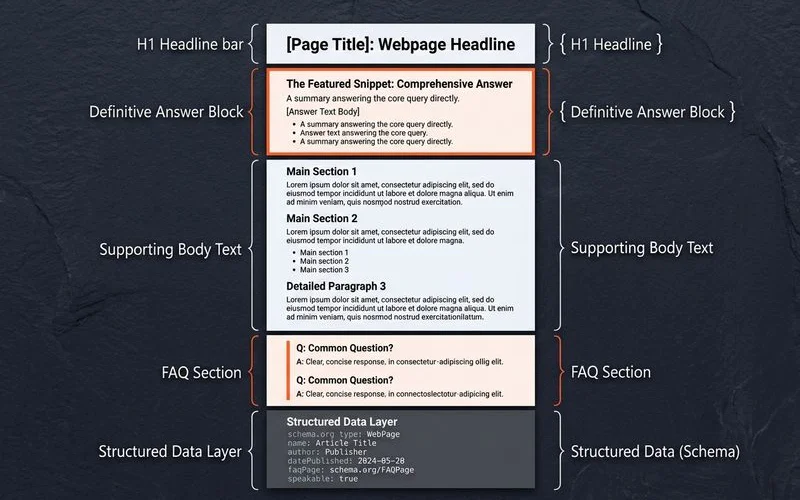
There are five key structural elements that define a page optimised for Answer Engine Optimization.
- Answer-first paragraph at the top. The most important information should be right at the top of the page, above the fold. This paragraph must directly answer the user’s implied question in one to three clear sentences. This is the section most engines will extract for their primary citation.
- FAQ block with schema. A dedicated Frequently Asked Questions section marked up with
FAQPageJSON-LD schema is one of the most effective ways to get cited. Research shows pages usingFAQPagemarkup are 3.2 times more likely to appear in Google AI Overviews. - Definitive single-sentence answers. AI engines ignore vague, hedging language like “it depends on many factors.” They look for clear, definitive statements such as “The process takes 5 days” or “The price is RM 250.”
- Heading structure that mirrors questions. Whenever it feels natural, your H2 and H3 headings should be phrased as questions. For example, use “How Long Does It Take to See SEO Results?” instead of a more generic title like “SEO Timeline.”
- Structured data for all key entities. Use
Organizationschema for your brand,Articleschema for your content, andFAQPagefor your FAQ section. For local Malaysian businesses, addingLocalBusinessschema with your address, opening hours, and contact number is crucial. You can find more details in our structured-data guide.
Why answer-format matters for citation extraction
Answer engines find and present information using a two-step process known as Retrieval-Augmented Generation, or RAG.
First is the retrieval step. The engine searches its index to find content that is relevant to the user’s query. This stage rewards the same signals as traditional SEO, such as topical authority, freshness, and relevance.
Second is the extraction step. From the content it retrieved, the engine then pulls out the most concise and accurate answer. This is where structural clarity becomes critical. The AI is looking for short paragraphs, direct answers, and clean schema markup. A page can rank number one in Google but still be ignored by answer engines if its content is not structured for easy extraction.
How AEO fits into a broader strategy
For the majority of Malaysian businesses, AEO should be integrated with, not replace, traditional SEO. The core principles of good SEO provide the foundation for AEO performance. However, the specific structural changes required for AEO, such as the answer-first format and FAQ schema, need dedicated attention.
Recent data shows that for local queries like “best nasi lemak in Petaling Jaya,” 73% now trigger an AI response in Google. This means if you’re a local brick-and-mortar business, getting cited in that answer is now essential for driving foot traffic. The game has changed from just being on the map to being the answer itself.
Our 4-Stage Framework integrates AEO by default into Stage 3, which covers on-page optimisation. We bundle these AEO enhancements for all our existing Premium and Elite tier clients at no extra charge because we see it as a non-negotiable part of modern SEO.
Want to audit your current AEO visibility? Start with our DIY AI-visibility self-audit, or book a free discovery call with our team.
Quick Answers
Is AEO different from voice search optimisation?
Do I need to redo all my content for AEO?
How quickly will AEO changes show up in AI engine responses?
Related Guides
AI Search vs Traditional Google Search — What's Changing in 2026
Zero-click trends, the share of search shifting to AI engines, what stays the same (intent matching), what changes (citation > ranking), and how to split your budget.
Is Your Brand Visible to AI? How to Audit AI Visibility
DIY AI-visibility self-audit checklist: search your brand in ChatGPT/Gemini/Perplexity, what good vs bad looks like, and what to do when you're not being cited.
How to Get Cited in ChatGPT, Gemini and Google AI Overviews
Practical playbook: structured-data signals, brand co-occurrence patterns, content formats LLMs prefer, and how to audit your existing AI citations today.
Schema Markup and Structured Data for AI Search Engines
Which schema types matter most for AI engines (Article, FAQ, HowTo, Organization), working JSON-LD examples, validation tools, and the implementation errors we see weekly.
Ready for the service?
Learn more about AEO & GEO — AI Search Optimization
Audit and improve your brand's visibility inside ChatGPT, Gemini, Perplexity, and Google AI Overviews — the new front door of organic search.
Explore the AEO / GEO Service